What Does CCA Mean on a Car Battery?
Car battery CCA means cold cranking amps, a rating of starting current in cold conditions. Meet your vehicle maker's minimum CCA requirement, then confirm the battery's size, terminal layout, and type.
On this page (9 sections)
- What does CCA mean on a car battery?
- How much car battery CCA do you need?
- Is a higher CCA rating always better?
- How does CCA differ from amp-hours and reserve capacity?
- Which battery examples suit different buyers?
- Can a battery analyzer help before you buy?
- What should you check before installation?
- Which mistakes reduce starting performance?
- How should you choose your car battery CCA?
Car battery CCA means cold cranking amps, a rating of how much current a battery can deliver to start an engine in cold conditions. Choose a replacement that meets your vehicle maker's minimum, with the correct size, terminal layout, and battery type.
Extra cold-starting current can help in winter, but the biggest number isn't automatically the best buy. Start with your vehicle's requirements, then compare compatible options.
What does CCA mean on a car battery?
CCA measures cold-starting current. Under the common SAE procedure, a fully charged 12V battery delivers its rated current for 30 seconds at 0°F while maintaining at least 7.2V.
Cold slows the chemical reactions inside a lead-acid battery, while thicker engine oil can make the engine harder to turn. The battery has less power available just as starting takes more effort.
CCA describes that short starting task. It doesn't tell you how long you can run accessories, how many years the battery will last, or whether it fits your car.
How much car battery CCA do you need?
Meet or exceed the vehicle maker's minimum CCA requirement. Find the specification for your exact model year, engine, and configuration in the owner's manual or a vehicle-specific parts reference.
Don't use engine size alone to calculate a replacement rating. Two vehicles with similar engines can have different battery requirements because their starting systems and electrical needs differ.
Choosing car battery CCA for your climate
Keep the recommended minimum even if you live somewhere warm. Moving to a mild climate doesn't remove the vehicle's starting-current requirement.
For cold winters, extra CCA can be useful when the battery also meets every fitment and capacity requirement. Compare suitable options in our guide to car batteries for cold weather.
Don't copy the old battery's number without checking it against the vehicle specification. A previous replacement may have been the wrong choice.
Is a higher CCA rating always better?
Higher CCA is useful only within a compatible battery choice. A battery with more starting-current capacity doesn't force that entire current into the starter; the starter draws what it needs.
If two options meet all requirements, extra CCA can provide more cold-starting margin. It doesn't compensate for loose connections, an undercharged battery, or a failing starter.
Fit comes before extra output. A battery that's too tall can create clearance problems, while reversed terminal positions can leave cables stretched or unable to connect.
The car battery group size guide explains these fit details. Use the car battery group size chart to narrow your options, then verify the exact vehicle application.
How does CCA differ from amp-hours and reserve capacity?
CCA measures starting current; amp-hours and reserve capacity describe capacity over time. You can't substitute one number for another or reliably convert CCA into amp-hours.
Amp-hours describe how much charge a battery supplies at a defined discharge rate. Reserve capacity describes how many minutes it can deliver a specified current before voltage falls to a set level.
For a daily driver, meet all capacity requirements the vehicle maker specifies. For a vehicle with start-stop operation or substantial electrical loads, choosing by CCA alone can overlook other needs.
A large reserve-capacity figure also doesn't turn a starter battery into a deep-cycle battery. Running accessories until the battery is nearly empty can shorten its life.
Which battery examples suit different buyers?
Choose among these batteries by vehicle fit first, then compare starting current and capacity. The H7 and H6 examples below serve different applications, so they aren't interchangeable upgrades.
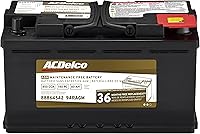
ACDelco Gold 94RAGM: for a confirmed H7 application
The ACDelco Gold 94RAGM suits drivers whose vehicle calls for a 12V AGM Group 94R/H7 battery. ACDelco backs it with a 36-month/unlimited-mile limited warranty for parts only.
Its leak-resistant vent design and envelope separator are construction features to consider alongside fit. At 53.2 pounds, it's also a replacement you'll want to plan to lift safely.
Skip it if your vehicle needs a different group size or terminal arrangement. Confirm its exact CCA before ordering, because the information here doesn't tell you whether it meets your vehicle's minimum.
Mighty Max MM-H7: for compatible cold-weather drivers
The Mighty Max MM-H7 offers 850 CCA, 80Ah, and 140 minutes of reserve capacity. It suits drivers with a confirmed Group 94R AGM application who want to compare both starting output and capacity.
It measures 12.50 x 6.88 x 7.48 inches, with positive on the right and negative on the left. Check that orientation against your cables, rather than relying on the group number alone.
Skip it if it won't fit the tray and hold-down, or if you need replacement installation hardware included. Mounting screws come with it, but a wire harness and other mounting accessories don't; confirm warranty coverage because Mighty Max gives conflicting terms.
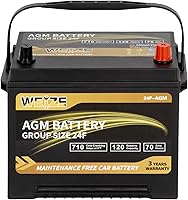
Weize Platinum Group 48 AGM: for confirmed H6 fitment
The Weize Platinum Group 48 AGM suits buyers replacing a compatible H6 battery, including suitable start-stop applications. It measures 10.94 x 6.89 x 7.48 inches, with negative on the left and positive on the right.
Resolve its capacity figures before buying: WEIZE gives both 760 and 680 CCA, plus both 70Ah and 60Ah. If your vehicle's minimum falls between those figures, don't assume the larger number applies to the unit you'll receive.
Skip it until those figures are confirmed for your exact model, and skip it for solar storage or marine deep-cycle use. WEIZE identifies this as an automotive starter battery, rather than a battery for those applications.
Can a battery analyzer help before you buy?
A conductance analyzer can estimate available CCA and help investigate weak starts. Its estimate isn't the same as the battery's original cold-chamber rating.
The Topdon BT200 Battery Load Tester supports 12V/24V batteries rated from 100 to 2,000 CCA. It also provides cranking and charging-system checks, which can help you investigate more than the battery alone.
It suits DIY drivers who want to check battery condition before replacing parts. Skip it if you need a charger or jump starter, since its role is diagnosis.
For a useful reading, select the correct battery type and rating standard, enter the label's rated current, and attach the clamps securely to clean terminals. Follow the prompts, and charge an undercharged battery before making a replacement decision based on its condition.
See how to check a car battery at home for the steps. If a replacement keeps losing charge, investigate why a car battery keeps dying before buying another.
What should you check before installation?
Confirm fit, charging compatibility, and any vehicle-specific replacement procedure before disconnecting the old battery. Some vehicles require battery registration or an electronic reset after replacement.
Check these points before starting:
- Match the group size, case dimensions, terminal position, and hold-down.
- Confirm the required battery type and any vent-hose connection.
- Check whether the vehicle requires battery registration.
- Have a safe way to lift and secure the replacement.
Follow the vehicle manual for disconnection and reconnection. A common negative-ground procedure removes the negative cable first and reconnects it last, but your vehicle's instructions take priority.
Secure the battery so it can't shift, and keep tools from bridging the terminals. For chemistry questions, read AGM versus flooded car batteries; our AGM car battery guide covers that replacement choice in more detail.
Which mistakes reduce starting performance?
Poor charge and poor connections can undermine a battery with enough CCA. Short trips may not replace all the energy used during starting, especially when electrical loads are high.
For a vehicle that sits unused, use a suitable maintainer if the vehicle and battery instructions recommend one. Select a charging mode compatible with the battery type.
Keep terminals clean and connections secure, and have recurring slow starts checked rather than assuming more CCA will solve them. Avoid repeated deep discharges and unnecessary accessory use with the engine off.
Also compare equivalent standards. CA or MCA isn't the same as CCA, and figures measured under SAE, EN, or DIN procedures shouldn't be treated as directly interchangeable.
How should you choose your car battery CCA?
Choose the correct fit and type, meet the required CCA and capacity, then consider extra cold-starting margin. That order keeps an impressive number from steering you toward the wrong battery.
Consider ACDelco for a confirmed H7 application after checking its CCA, or Mighty Max when its stated output and capacity meet your H7 requirements. Choose Weize for a confirmed H6 application only after resolving its conflicting figures.
Use the Topdon analyzer when you need to investigate the battery's condition before replacing it. For the complete buying sequence, follow how to choose a car battery; a vehicle guide such as what size battery a Toyota Camry takes can help narrow the fit.
Frequently asked questions
What does CCA mean on a car battery?
CCA means cold cranking amps, a measure of starting current in cold conditions. Under the common SAE procedure, a fully charged 12V battery must deliver its rated current for 30 seconds at 0°F while maintaining at least 7.2V; compare figures that use the same standard.
Is higher CCA better for a car battery?
Higher CCA can give you more cold-starting current when both batteries fit and meet your vehicle's requirements. It doesn't replace the need for the correct group size, terminal layout, and battery type; extra CCA also doesn't tell you how long the battery can power accessories or how long it will last.
How many CCA does my car battery need?
Use your vehicle maker's minimum CCA requirement for the exact model year, engine, and configuration. Check the owner's manual or a vehicle-specific parts reference, then choose a compatible battery that meets or exceeds that figure; don't assume the battery already installed is the correct replacement reference.
Is CCA the same as amp-hours?
No, CCA describes starting current in cold conditions, while amp-hours describe charge capacity at a defined discharge rate. A battery can meet your CCA requirement yet fall short of your vehicle's capacity requirement; check both where specified, along with reserve capacity, physical fit, and the required battery type.