How Do You Test a Car Battery at Home?
Here's how to test a car battery: measure resting voltage with a multimeter, or use a compatible battery tester for health, cranking, and charging checks. Start with the ignition and accessories off, and enter the battery's exact type and rating when prompted.
On this page (8 sections)
- What do you need to test a car battery at home?
- How do you test a car battery with a multimeter?
- How do you use a dedicated car battery tester?
- Which tester suits different batteries or solo use?
- What do recharge, replace, and good results mean?
- Can you check the alternator and starting system at home?
- Which mistakes should you avoid between checks?
- How to test a car battery and choose your next step
Here's how to test a car battery at home: measure its resting voltage with a multimeter, or connect a compatible battery tester for a fuller health check. Begin with the ignition and accessories off, then follow the tool's prompts before starting the engine.
A voltage reading helps you judge charge level. A dedicated tester adds information about battery condition and, on the models below, cranking and charging performance.
What do you need to test a car battery at home?
Use a digital multimeter for charge checks or a compatible battery tester to help decide whether a battery needs charging or replacement. If you already own a suitable meter, start there before buying another tool.
Check your battery's voltage, chemistry, and label before choosing a tester. These picks serve 12V lead-acid batteries; don't assume a tool also supports lithium, 6V, or a complete 24V system.
Read the vehicle manual for battery access and approved connection points. Some cars have remote jump terminals, and those aren't automatically the right place for every battery health check.
If you don't know your battery type, use the AGM battery guide to identify what to look for. Our AGM versus flooded battery comparison explains why selecting the correct chemistry matters.
How to prepare for a car battery test
Park securely and inspect the battery before connecting anything. Apply the parking brake, switch off electrical loads, and allow the battery to rest after driving or charging as the manuals direct.
Wear eye protection, remove metal jewelry, and keep tools from bridging the terminals. Stop if the case is cracked, swollen, leaking, unusually hot, or possibly frozen.
Keep flames and sparks away. If corrosion prevents firm contact, follow the vehicle manual's cleaning procedure rather than forcing clamps onto a dirty connection.
How do you test a car battery with a multimeter?
Measure DC voltage across the terminals with the engine off. Recent driving or charging can leave surface charge that makes the reading look higher, so don't skip the rest period.
- Put the black lead in COM and the red lead in the voltage socket.
- Select DC volts, using automatic ranging or a range above the expected battery voltage.
- Touch red to positive and black to negative, keeping the probe tips apart.
- Read the display, then remove the probes without touching nearby metal.
Never select current, resistance, or continuity mode across the battery. The wrong socket or mode can cause a short circuit, so check the meter before making contact.
A fully charged 12V lead-acid battery commonly rests around 12.6–12.8V, depending on chemistry and temperature. Around 12.4V suggests a partial charge, while around 12.2V suggests a substantially discharged battery.
Treat these as rough guides, not replacement thresholds. A low reading calls for a suitable charge and another check; a normal reading doesn't prove the battery can deliver enough current to start the engine.
A negative display usually means the probes are reversed. Remove them and confirm terminal markings before reconnecting.
For the difference between voltage and starting output, read what CCA means on a car battery. Don't compare a voltage reading directly with the CCA number on the label.
How do you use a dedicated car battery tester?
Connect the clamps securely and enter the battery's exact settings. A wrong chemistry, rating number, or rating standard can lead you toward the wrong decision.
- Leave the engine, lights, climate control, and other loads off.
- Attach red to positive and black to negative at the required connection points.
- Select the battery chemistry and any in-vehicle or out-of-vehicle option requested.
- Enter the label's rating and matching standard, such as CCA or EN.
- Run the battery health check and save or note the result.
Don't substitute amp-hours for CCA or guess an unreadable number. Find the correct specification before continuing.
Cranking and charging checks are separate steps that require the engine to run. Work outdoors and secure cables away from belts, fans, and hot parts before following those prompts.
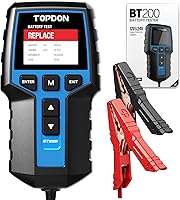
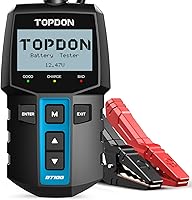
Topdon BT100: choose it for occasional home checks
The BT100 suits drivers who want menu-based checks with color indicators. It covers battery health, cranking, and charging, with 3 LED colors to help flag battery condition.
It supports 100–2000 CCA flooded, AGM flat-plate and spiral, EFB, and GEL batteries. Its compact body fits a glove box or center console, and it draws power from the connected battery.
Choose it for periodic checks across compatible household vehicles. Skip it if your main need is viewing the screen from the driver's seat; the Foxwell below has a stated long-cable advantage.
Topdon BT50: choose it for repeat checks
The BT50 suits drivers who want one-button operation and a data review feature for comparing results over time. Its LCD and 6 interface languages also help if more than one person will use it.
It supports 100–2000 CCA batteries and powers up from the connected battery. Below 8V, it stops the check and displays a low-voltage message.
Skip it if you need a reading from a deeply discharged battery below that threshold. An undamaged battery may need an appropriate charge first; the message alone doesn't prove it needs replacement.
Which tester suits different batteries or solo use?
Choose the Ancel for its range of supported standards, or the Foxwell for easier screen placement. All 4 tools cover battery, cranking, and charging checks, so those shared functions aren't the deciding difference.
Ancel BA101: choose it for different label standards
The BA101 suits a home garage handling batteries with different rating standards. It supports standards including JIS, EN, DIN, SAE, BCI, and IEC, with an adjustable-contrast screen and white backlight.
It covers 100–2000 CCA 12V flooded, AGM, GEL, and EFB batteries. Enter the correct label values and any requested temperature setting rather than leaving a convenient default.
Skip it for lithium, non-12V batteries, or motorcycle batteries below 30Ah. That last limit matters if your main reason for buying a tool is maintaining a small motorcycle.
Foxwell BT301: choose it for working alone
The BT301 suits solo cranking and charging checks, thanks to its 6.5 ft cable. Its 2.8-inch color screen can sit closer to you while the clamps remain under the hood, where the vehicle layout allows.
It supports 100–2000 CCA 12V flooded, AGM flat, AGM spiral, EFB, and GEL batteries, with results including GOOD, RECHARGE, and REPLACE. It needs no app or separate internal battery.
Skip it for lithium batteries, or if a longer cable adds no value to your routine. Never route the lead where a door or hood can pinch it, and don't stretch it across moving parts.
What do recharge, replace, and good results mean?
Recharge means restore charge before judging health; replace means confirm the setup and act on a repeated failure result. GOOD means the battery passed that check, not that every part of the car's electrical system is sound.
For a recharge result, use a charger suited to the battery chemistry and follow the vehicle's charging instructions. Let the battery rest as directed before repeating the same check with the same settings.
For a replace result, first confirm clean clamp contact and correct battery details. A repeated failure result on a properly charged battery is a stronger reason to replace it than one low-charge reading.
Battery age adds context but isn't a pass-or-fail rule. See how long a car battery usually lasts before deciding that age alone settles the question.
If the battery passes but soon goes flat again, investigate the cause. Our guide to why a car battery keeps dying covers short trips, charging faults, and other possible drains.
Can you check the alternator and starting system at home?
Use the tool's cranking and charging modes to narrow down the problem. A weak start can involve the battery, cable connections, or starter, while low charge can come from a charging fault.
Follow each prompt rather than applying one universal running-voltage target. Smart charging systems can vary alternator output, so a single meter reading may be hard to interpret without vehicle-specific guidance.
Never disconnect a battery cable with the engine running to check the alternator. Run the engine outdoors, and keep hands, clothing, and leads clear of belts and fans.
Get professional help if warning lights remain on, results conflict, or the car still won't start after a suitable charge. More battery checks won't resolve a loose cable or diagnose every starter fault.
Which mistakes should you avoid between checks?
Use consistent settings and keep the tool's connections in good condition. Comparing results after different rest periods or with different rating entries can make a healthy battery appear to change.
Don't leave lights or accessories running during the initial health check. Avoid repeated start attempts on a weak battery, and don't treat a jump-start as a full recharge.
After use, remove the clamps as the manual directs, inspect the cable insulation, and store the tool dry. Keep clamps clean and avoid sharply bending leads or closing the hood on them.
How to test a car battery and choose your next step
Start with a multimeter if you only need charge information; buy a dedicated tester for repeat health checks. Choose the BT100 for menus and LED cues, the BT50 for data review, the BA101 for varied standards, or the BT301 for cable reach.
When deciding how to test a car battery, check compatibility before extra features. Compare the options in our car battery tester guide, especially if your household has several battery types.
Charge and recheck a low battery; investigate recurring discharge or a no-start despite a good result. If replacement is the clear next step, use how to choose a car battery to match fit, chemistry, and starting needs.
Frequently asked questions
Can I test a car battery with a multimeter?
Yes, a multimeter can measure resting voltage, which helps you judge charge level. Use DC volts with the leads in the voltage and COM sockets, and connect red to positive and black to negative; never use current mode across the terminals; voltage alone cannot confirm starting ability.
Should the car be running when I test the battery?
Keep the engine and accessories off for resting voltage and the initial battery health check. Start the engine only when the tool directs you to run a cranking or charging check; work outdoors, with the parking brake applied and all leads secured away from belts and fans.
What does a car battery tester check?
A compatible battery tester can assess charge and health, while models with cranking and charging checks add information about starting performance and alternator operation. Results depend on a secure connection and correct settings; match the battery type, rating number, and rating standard to the battery label rather than guessing.
When should I get a professional battery test?
Get professional help if the battery is swollen, leaking, cracked, unusually hot, or unsafe to reach. Repeated no-starts also deserve an inspection when a charged battery gives an acceptable result; a mechanic can check cable connections, the starter, the charging system, and electrical drains that a battery check may miss.