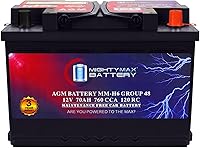
AGM vs Flooded Car Batteries: What Is the Difference? (November 2026)
The AGM vs flooded battery difference is how the electrolyte is held: glass mats in AGM, free-flowing liquid in flooded. Choose your vehicle's required type first, then check fit, starting power and charging needs.
On this page (11 sections)
- AGM vs flooded battery: what is the main difference?
- How do AGM and flooded batteries compare in daily use?
- Which battery type does your car need?
- Who should choose the Weize Platinum AGM?
- Who should choose the Interstate M-24F flooded battery?
- What should you check before buying either type?
- How should you install and charge the replacement?
- How do you care for AGM and flooded batteries?
- Which mistakes waste money on a replacement battery?
- Which AGM vs flooded battery should you choose?
- Sources
The AGM vs flooded battery choice starts with your car's requirements: use AGM when required, and choose flooded when the vehicle permits it and its starting needs are met. AGM holds electrolyte in glass mats; flooded batteries contain free-flowing liquid electrolyte.
That difference affects upkeep, spill resistance and repeated discharge and recharge. It doesn't make either type the right replacement for every car.
The 2 Group 24F options below show how the choice works in practice. Confirm compatibility before choosing between them, because sharing a group number doesn't make these batteries interchangeable.
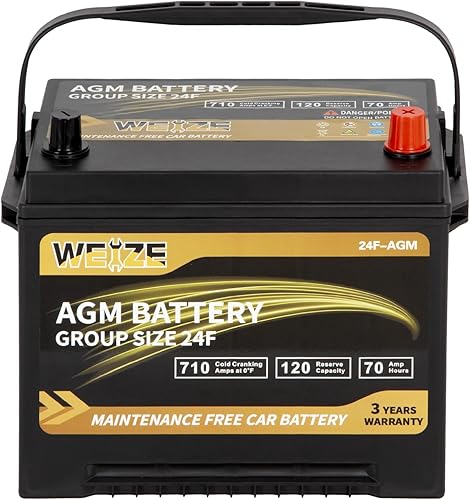
 Best for conventional daily drivers
Interstate Group 24F Flooded (M-24F)
AGM vs flooded battery: what is the main difference?
The main difference is how the electrolyte sits around the lead plates. Both are lead-acid batteries, but AGM uses absorbent glass mats while flooded construction leaves the electrolyte as liquid.
AGM stands for absorbent glass mat. Its valve-regulated construction needs no water top-ups, though it can release gas under abnormal charging conditions.
Flooded batteries also release gas during charging, and their liquid electrolyte makes upright handling especially important. Some have serviceable caps, while others are sealed against routine water maintenance.
For the driver, the useful distinction is the job each design can handle. AGM generally suits repeated cycling better, while conventional flooded batteries suit ordinary starting duty in vehicles designed for them.
Neither construction turns a starter battery into a power supply for long engine-off sessions. Repeatedly running either type flat can shorten its useful life.
How do AGM and flooded batteries compare in daily use?
AGM favors cycling demands; flooded favors conventional starting duty. Both depend on correct charging, secure mounting and a battery that meets the vehicle's requirements.
| Product | Best for | Type | Group size | CCA | Our score |
|---|---|---|---|---|---|
| Weize Platinum Group 24F AGM | AGM-equipped commuters | AGM | 24F | 710 | 8.3 |
| Interstate Group 24F Flooded (M-24F) | conventional daily drivers | Flooded lead-acid | 24F | 530 | 6.5 |
AGM vs flooded battery for maintenance
AGM removes water top-ups from your care routine. It still needs clean terminals, secure connections and enough charge to avoid sitting partly discharged.
For flooded batteries, follow the exact model's instructions. Don't assume every flooded case opens, and never pry off a sealed cover to check the electrolyte.
Visible corrosion, loose clamps or a damaged hold-down deserve attention with either type. Our guide to checking a car battery at home explains basic checks before further diagnosis.
Spill resistance and vibration
AGM holds its electrolyte in place, which reduces spill risk and helps it cope with vibration. That makes its construction useful, but doesn't excuse a loose mount or rough handling.
A flooded battery needs the correct upright position and hold-down. Neither type should move around in its tray, press against the hood or pull on its cables.
Short trips and parked vehicles
Repeated short trips can leave either battery undercharged because the engine starts consume energy that brief drives may not replace. AGM doesn't remove that charging deficit.
For a car that sits, a compatible maintainer can help if the vehicle and battery instructions allow one. Lower self-discharge won't overcome an ongoing electrical drain.
Which battery type does your car need?
Use the battery type approved for your exact vehicle. Start with the owner's manual or vehicle service information rather than assuming the battery already fitted is correct.
A factory AGM requirement can reflect start-stop operation, electrical loads or the charging system's design. Replacing it with flooded simply because the case fits can create the wrong match.
Start-stop alone isn't a complete specification, either. Some vehicles use enhanced flooded batteries, often called EFB, so identify the required technology before ordering.
A car built for conventional flooded batteries may allow an AGM upgrade, but approval matters. The charging strategy, installation location and battery-management settings must suit the replacement.
Read our AGM battery buying guide for the main specification checks. If the required type remains unclear, have a service professional confirm it before buying.
Who should choose the Weize Platinum AGM?
The Weize suits compatible Group 24F vehicles that require AGM or approve it for repeated stop-start use. Skip it if your car needs another size, an incompatible terminal layout or a different charging setup.
Its 710 CCA starting output exceeds the compared Interstate's 530 CCA. That gives you another option when the vehicle's minimum requirement rules out the Interstate, provided every other fit requirement matches.
The Weize also has 70 Ah capacity and 120 minutes of reserve capacity. Those figures describe stored energy and discharge performance; they don't promise a fixed number of engine-off hours for your accessories.
WEIZE backs it with a 3-year warranty. Check the warranty process before ordering, particularly how a failed battery would be assessed and where you'd take it.
WEIZE describes lower self-discharge and improved cycling compared with conventional batteries. Those features suit the AGM use case, but they don't make this automotive starter battery suitable for solar storage or deep-cycle marine service.
Its height needs confirmation before you buy. WEIZE gives both 8.98 inches and 8.19 inches, a difference that matters under a close-fitting hood or battery cover.
The AGM vs regular battery comparison helps you decide whether an approved upgrade serves your driving pattern. Buying AGM to solve an unexplained charging problem should come after diagnosis.
Who should choose the Interstate M-24F flooded battery?
The Interstate suits conventional daily drivers approved for flooded batteries, provided its starting output meets their requirements. Skip it when the vehicle requires AGM, EFB or more starting current than this model supplies.
Its 95-minute reserve capacity gives you a useful comparison point for stored backup energy. It isn't a promise that your car will keep running for that long after an alternator failure.
The case measures 10.75 x 6.90 x 8.86 inches, with top-post terminals. Compare those measurements with the tray, clamp and overhead clearance rather than relying on Group 24F alone.
Interstate backs the M-24F with an 18-month performance warranty. Warranty length is one buying factor, but correct fit and battery type come first.
Interstate includes a refundable core deposit and directs buyers to an Interstate All Battery Center for the return. Read the battery core charge guide so you know what to arrange for your old battery.
Don't choose this model solely because your car has few accessories. Engine starting requirements can still rule it out, even in a simple vehicle without start-stop.
What should you check before buying either type?
Check type, physical fit, starting output and charging compatibility before comparing extra features. A replacement needs to pass every check.
Match the case, hold-down and terminals
Group size narrows the search, but exact measurements settle clearance questions. Check the full installed height, including the terminals, and make sure any cover can close correctly.
The car battery group size guide explains the code. Your vehicle's fit information should also confirm the mounting arrangement and terminal positions.
The Weize uses a left negative and right positive terminal arrangement in WEIZE's stated orientation. Confirm the viewing direction and compare it with your cables before ordering.
Cables should reach naturally without stretching, crossing or touching sharp edges. Never turn a battery around to force a match if that compromises clearance or mounting.
Use CCA as a minimum requirement
CCA measures a battery's ability to supply starting current in cold conditions. Meet or exceed the vehicle maker's minimum without sacrificing the required type or fit.
Our CCA guide explains the number in more detail. A higher CCA figure doesn't fix the wrong terminals, an unsuitable charging system or a battery that won't secure properly.
Separate reserve capacity from accessory runtime
Reserve capacity measures discharge time under a defined load and conditions. Amp-hours describe capacity under a specified discharge rate, so the numbers aren't interchangeable.
Use comparable figures to assess options after fit is confirmed. Real accessory runtime depends on the load, temperature, charge level and how much starting reserve you need to retain.
How should you install and charge the replacement?
Follow the vehicle's replacement procedure and the battery's charging instructions. Some cars need registration or a battery-management reset, and some installations are best handled by a service shop.
Before removal, check whether the vehicle needs memory protection, special access steps or a vent connection. Turn the vehicle off, keep sparks and flames away, and wear eye protection and gloves.
For a conventional negative-ground vehicle, the usual removal order is negative cable first, then positive. Reconnect positive first and negative last, unless the vehicle's instructions specify another procedure.
Secure the new battery with the correct hold-down without overtightening it. Reconnect any required vent tube and make sure protective terminal covers are back in place.
For external charging, choose a charger with a mode approved for the battery. Don't use a high-voltage repair or equalization setting on AGM unless the battery manufacturer expressly permits it.
WEIZE specifies a 14.4–15.0 V charging range and up to 21 A charging current for this model. Use those limits with its charging instructions, rather than treating them as universal settings for all AGM batteries.
If the car requires battery registration, complete that step after installation. It lets the battery-management system account for the replacement according to the vehicle's procedure.
How do you care for AGM and flooded batteries?
Keep both types charged, clean and securely mounted. AGM reduces electrolyte upkeep, but it doesn't remove the need to watch for charging problems.
Avoid leaving headlights or accessories running with the engine off for long periods. A starting battery needs enough energy left to crank the engine, even when it can tolerate some cycling.
If a serviceable flooded battery requires water checks, follow its fill instructions and use distilled water. Don't add acid during routine maintenance or overfill the cells.
Before storage, follow the vehicle's guidance on charging, maintaining or disconnecting the battery. Disconnecting without checking can affect security systems and stored settings.
Stop using a battery that is swollen, leaking or visibly damaged. Don't charge a frozen battery, and have the cause of damage assessed before fitting a replacement.
Heat, chronic undercharging and repeated deep discharge can shorten life with either design. A warranty period isn't a forecast of how long the battery will last in your car.
Which mistakes waste money on a replacement battery?
The biggest mistake is buying a new battery before finding why the old one loses charge. A charging fault or electrical drain can leave the replacement flat too.
If your battery repeatedly dies, the guide to why a car battery keeps dying helps separate likely causes. An AGM upgrade won't repair a faulty alternator or stop a parasitic drain.
Another mistake is treating any battery with better cycling ability as a deep-cycle battery. Neither of these automotive starting choices is the right answer for regularly powering equipment until the battery is nearly empty.
Don't assume a longer warranty makes an incompatible battery the safer buy. A shorter-warranty model that meets the vehicle's requirements is more useful than one with the wrong chemistry or mounting arrangement.
Finally, plan the old battery's return before installation. Lead-acid batteries need proper recycling, and the return route may also affect a core-deposit refund.
Which AGM vs flooded battery should you choose?
For an AGM vs flooded battery decision, choose the required technology first, then eliminate anything that fails the fit or starting checks. Use your driving demands to compare the remaining approved options.
Pick the Weize when your vehicle accepts this Group 24F AGM and its case height is confirmed. It is the relevant option here for AGM-equipped cars and compatible stop-start applications.
Pick the Interstate when your vehicle permits conventional flooded construction and this model meets its starting needs. It suits ordinary replacement duty without requiring a change in battery technology.
Choose neither if the group size, terminals, venting or vehicle requirements don't match. Use how to choose a car battery to build a shortlist around your exact car before comparing brands.
Sources
These resources explain lead-acid battery construction and use. Your vehicle's manual remains the reference for its replacement requirements.
Frequently asked questions
Is an AGM battery better than a flooded battery?
AGM is the better choice when your vehicle requires it or approves it for repeated stop-start use and higher electrical demands; flooded remains a sensible choice for compatible conventional vehicles. Neither type wins on construction alone: fit, charging compatibility and the vehicle's minimum starting requirements decide which one you should buy.
Can I replace an AGM battery with a flooded battery?
Keep AGM when your vehicle requires AGM; a flooded battery may fit the same tray but lack the cycling ability or charging compatibility the vehicle expects. Change types only with vehicle-maker approval, and confirm whether the replacement requires battery registration or a battery-management reset before installation.
Do flooded car batteries need maintenance?
Some flooded batteries need water checks, while others are maintenance-free; follow the instructions for the exact model rather than assuming removable caps are present. Never pry open a sealed case, and use only distilled water when a serviceable battery's instructions call for topping up its electrolyte level.
Do AGM batteries last longer than flooded batteries?
AGM can handle repeated cycling better than conventional flooded designs, but service life still depends on heat, charge level, driving habits and the charging system; a suitable flooded battery kept charged can serve a conventional vehicle well. Don't treat a warranty period or cycle-life claim as a promised replacement date.
How do I know which battery fits my car?
Match the required battery type, group size, minimum CCA, case dimensions and terminal layout to your exact vehicle; also check the hold-down, vent connection and any battery-management procedure. Use the owner's manual and vehicle fit information together, especially if you don't know whether the current battery was correctly chosen.