What Does Battery Group Size Mean?
A car battery group size identifies a standard case size and terminal layout. Match your vehicle's full group code, then confirm dimensions, hold-down fit, battery type, and minimum CCA before buying.
On this page (7 sections)
- What does car battery group size mean?
- How do you find the right group size for your car?
- What should you check beyond the group code?
- Which battery suits each group-size requirement?
- Can you use a different group size or battery type?
- How should you prepare for installation and care?
- Which car battery group size should you choose?
A car battery group size identifies a standard case size and terminal arrangement. Choose the full code your vehicle requires, then check physical fit, battery type, and starting output before buying.
The group number isn't a power ranking: Group 65 isn't automatically a better choice than Group 35. A replacement must fit the tray, stay secure, and connect without stretching the cables.
What does car battery group size mean?
Group size is a fit code, not a measurement in inches or a measure of battery strength. It describes a general case size and terminal arrangement used to match batteries to vehicles.
The full designation matters, including letters such as the F in 24F. Similar numbers or similar-looking cases don't make two batteries interchangeable.
Use our car battery group size chart to understand the codes. Then use a vehicle-specific fit guide to confirm which one your car needs.
Group size also doesn't tell you how much energy a battery stores. Two batteries with the same fit code can differ in capacity, starting output, and construction.
How do you find the right group size for your car?
Start with the owner's manual and a fit guide for your exact vehicle. Include the model year, make, model, engine, and any equipment choices the guide asks about.
The old battery's label is useful, but it isn't proof of the correct replacement. A previous owner may have fitted an unsuitable battery, or your vehicle may have more than one approved option.
If the label is unreadable, record the case measurements and photograph the terminals and hold-down. Use those details to help a parts professional identify the right replacement rather than guessing from appearance.
Our guide on how to choose a car battery covers the full selection process. For an example of why vehicle details matter, see what size battery a Toyota Camry takes.
What should you check beyond the group code?
Check fit, battery type, and starting requirements together. Passing just one of these checks doesn't make a battery suitable.
- Case dimensions: Compare length, width, and overall height, including terminal clearance.
- Hold-down fit: The restraint must engage the case correctly and prevent movement.
- Terminal layout: Match polarity, terminal style, and cable reach.
- Battery type: Follow the vehicle's AGM, flooded, or other specified requirement.
- Starting output: Meet or exceed the vehicle's minimum CCA.
- Venting: If the original installation uses a vent tube, confirm the replacement supports the required connection.
CCA means cold cranking amps, which describes starting output in cold conditions. Our guide to CCA on a car battery explains how to compare it separately from size.
Amp-hours describe capacity, while reserve capacity describes how long a battery can support a defined load. Neither makes an automotive starter battery suitable for repeated deep discharge.
Which battery suits each group-size requirement?
Choose among these batteries by approved fit first, then compare their electrical specifications. Each serves a different replacement need, so there isn't one winner for every car.
All 4 options here are AGM batteries. Drivers whose vehicles permit a conventional flooded replacement can compare that route separately rather than assuming AGM is required.
Car battery group size 24F: who should choose the Weize?
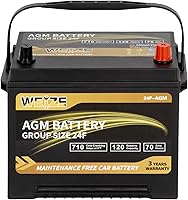
The Weize Platinum Group 24F AGM suits a vehicle that calls for 24F, accepts AGM, and needs no more than its 710 CCA. Its 70 Ah capacity is another specification to compare with the vehicle's requirements.
The case footprint is 10.75 x 6.81 in. WEIZE gives conflicting height figures of 8.19 and 8.98 in, so get the overall height confirmed before ordering, especially under a close-fitting hood or cover.
Choose it for a confirmed 24F replacement, not as a substitute for a battery labeled only 24. Skip it if terminal orientation differs or the required starting output is higher.
WEIZE backs it with a 3-year warranty. Treat warranty coverage as support after a problem, not a promise of a fixed service life.
Who should choose the Weize Group 35?
The Weize Platinum Group 35 AGM suits an approved Group 35 application requiring up to 650 CCA. Its 55 Ah capacity makes it a separate electrical choice from the larger-capacity WEIZE options here.
Its footprint is 9.06 x 6.89 in. WEIZE gives height figures of 8.03 and 8.82 in, so confirm total height rather than assuming the shorter case length means easy clearance.
Choose it when the vehicle fit guide confirms Group 35 and its output meets the requirement. Skip it if you're trying to fill a larger tray without an approved restraint or need more starting output.
WEIZE backs this model with a 3-year warranty. At 37.7 lb, it still needs careful lifting and a clear path into the tray.
Who should choose the ACDelco Gold 48AGM?
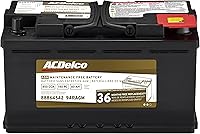
The ACDelco Gold 48AGM suits an approved Group 48/H6 application that requires AGM construction. ACDelco describes it as suitable for start-stop use and backs it with a 36-month free-replacement limited warranty.
It measures 11.9 in wide, 7.5 in deep, and 7.6 in high, and weighs 45.5 lb. Plan the lift before removing the old battery, especially if the tray is recessed.
Choose it after confirming the exact vehicle application and required starting output. Get its CCA confirmed before ordering if you can't verify that requirement through a vehicle-specific match.
Skip it for a different group designation unless an approved fit reference names it as an alternative. The ACDelco Gold 48AGM review covers this model in more detail.
Who should choose the Weize Group 65?
The Weize Platinum Group 65 AGM suits a confirmed Group 65 application needing up to 750 CCA. It has a 70 Ah capacity and a 3-year WEIZE warranty.
Its case is about 12 in long, with width and height both 7.56 in. WEIZE gives length figures of 12 and 12.05 in, so resolve that difference if your tray has little spare room.
WEIZE describes its terminals as positive on the left and negative on the right, opposite the two WEIZE examples above. Compare marked posts from the same viewing direction, since turning a battery around changes what “left” means.
Skip it if you're choosing it only for the higher CCA. A longer case or reversed cable layout can rule it out before output becomes relevant.
Can you use a different group size or battery type?
Use a different group only when the vehicle manufacturer or a reliable fit guide approves the alternative. Extra room in the tray isn't enough, because the hold-down, cables, and hood clearance must still work.
Don't force a taller battery under a cover, stretch a cable, or improvise a restraint. Terminal contact with nearby metal can cause a short circuit.
Battery type needs its own check. Keep AGM where the vehicle requires it, and confirm charging-system compatibility before changing from flooded to AGM.
Read our AGM car battery guide for the construction differences. If you're unsure what your vehicle requires, start with whether your car needs an AGM battery.
How should you prepare for installation and care?
Follow the vehicle's replacement procedure before disconnecting anything. Some vehicles need battery registration, a reset, or specific steps to preserve settings and manage charging correctly.
Before fitting the replacement:
- Switch the vehicle off and follow its instructions for key placement and waiting time.
- Wear eye protection and gloves, and keep flames, sparks, and metal jewelry away.
- Check the tray, restraint, cable ends, and any vent connection.
- For conventional negative-ground systems, disconnect negative first, then positive; reconnect positive first, then negative.
- Secure the battery and tighten connections to the vehicle's specifications.
Get help if access is awkward or the procedure needs equipment you don't have. Never bridge the terminals with a tool, and wash your hands after handling a lead-acid battery.
For care, keep the terminals clean and check that the restraint remains secure. AGM batteries don't need water added, and you shouldn't open their case.
If the car sits unused, use a compatible maintainer according to the battery and vehicle instructions. Repeated short trips and parked electrical loads can leave a correctly sized battery undercharged.
Before ordering online, read our guide to buying a car battery online so you can plan delivery, returns, and disposal of the old battery.
Which car battery group size should you choose?
Choose the car battery group size approved for your exact vehicle, then eliminate any battery that fails the terminal, restraint, type, or electrical checks. Resolve conflicting dimensions before placing the order.
Pick the WEIZE 24F, 35, or 65 only for the matching approved application. Choose the ACDelco 48AGM when Group 48/H6 AGM is confirmed and its starting specification meets your vehicle's needs.
If none passes every check, keep looking rather than adapting the car around a near match. Use the group size chart for reference, or the Toyota Camry battery fit guide for that vehicle.
Frequently asked questions
What does a group size mean on a car battery?
A car battery group size is a standard code for the battery's general case dimensions and terminal arrangement. It narrows your options but doesn't tell you its battery type or starting output.
Match the full code to your vehicle, then check measurements, hold-down fit, terminal positions, and minimum CCA.
Can I use a different group size battery?
Use a different group size only when your vehicle manufacturer or a reliable vehicle-specific fit guide approves it. A battery can fit inside the tray yet fail to secure under the hold-down.
The alternative must also meet terminal reach, hood clearance, battery type, venting, and starting requirements.
Are Group 24 and 24F batteries the same?
No. Group 24 and 24F are separate designations, and terminal placement can differ, so you shouldn't treat them as interchangeable.
Match the complete code your vehicle requires and compare the marked positive and negative posts from the same viewing direction before deciding that either battery will fit.
Does group size tell me a battery's CCA?
No. Group size describes physical fit and terminal arrangement, while cold cranking amps describe starting output in cold conditions.
Batteries within one group can have different CCA, so check the vehicle's minimum separately.
Extra CCA cannot make up for a case that doesn't fit or cables that cannot reach safely.