What Size Battery Does a Toyota Camry Take?
The right battery for a Toyota Camry depends on its model year, engine, and equipment. Confirm Toyota’s replacement requirements, then match group size, case dimensions, terminal layout, battery type, and minimum CCA.
On this page (8 sections)
- What size battery does a Toyota Camry take?
- What must match before you buy a Camry battery?
- Does your Camry need an AGM or flooded battery?
- How do the Mighty Max alternatives compare?
- How should you prepare for battery replacement?
- How can you help the replacement battery last?
- Which buying mistakes should you avoid?
- Which battery for a Toyota Camry should you choose?
The right battery for a Toyota Camry depends on its model year, engine, and equipment. Confirm Toyota’s replacement requirements first, then use the current battery label to cross-check the size and type.
Group 24F and Group 35 AGM batteries are options to compare only when approved for your vehicle. A larger case or higher capacity is no reason to choose a battery that won't fit securely.
What size battery does a Toyota Camry take?
There is no single battery size for every Camry. Find the approved replacement specification for your exact vehicle before comparing brands.
Start with Toyota’s owner manuals and warranty guides. If the manual doesn't give enough detail, have Toyota or a qualified parts specialist check your VIN.
For a hybrid, confirm that you're shopping for the correct low-voltage auxiliary battery. The batteries discussed here are not replacements for a hybrid traction battery.
How do you identify the battery group for your Toyota Camry?
Read the group code on the existing battery, then verify it against Toyota’s guidance. Codes such as 24F and 35 help identify case dimensions and terminal arrangement.
Use our car battery group size chart to understand the measurements. Our guide to what car battery group size means explains why a similar-looking case can still be wrong.
Treat the old battery as a reference, not final proof. A previous replacement could have used an unsuitable size or type.
What must match before you buy a Camry battery?
The replacement must meet both physical fit and electrical requirements. Check these points before comparing capacity or brand:
- Approved group size: Match Toyota’s specification for your exact configuration.
- Case dimensions: Check length, width, total height, and clearance above the posts.
- Hold-down fit: The original restraint must secure the case without makeshift parts.
- Terminal layout: The cables must reach the correct posts without pulling or crossing.
- Battery construction: Use the required or approved type.
- Starting power: Meet or exceed Toyota’s minimum CCA.
Compare terminal positions from the same viewing direction. A positive-right description can be misleading if you're looking at one battery from the opposite side.
CCA measures cold-start capability, while amp-hours describe capacity and reserve capacity describes a standardized discharge duration. Our guide to what CCA means on a car battery explains which number matters most for cold starts.
Reserve capacity isn't a promise that your Camry can run its accessories for that many minutes. Actual runtime depends on the load and battery condition.
Does your Camry need an AGM or flooded battery?
Use the construction Toyota specifies, and confirm approval before changing types. If AGM is required, stay with AGM.
AGM holds its electrolyte in glass mats rather than leaving it free-flowing like a conventional flooded battery. It still needs compatible charging and secure installation.
All 4 options below are AGM batteries, so they don't cover every possible Camry requirement. Read AGM vs flooded car batteries for the basic differences, or our AGM car battery guide for charging and selection help.
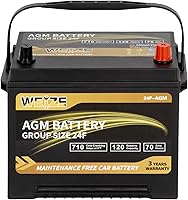
Which Weize battery suits an approved Camry fit?
Choose the Weize model that matches your approved group size. The Group 24F suits a confirmed 24F application; the Group 35 suits a confirmed Group 35 application.
The Weize Platinum Group 24F AGM also has a 120-minute reserve capacity. It suits buyers whose Camry requires this larger case and whose electrical requirements fall within its specifications.
Skip it if your vehicle calls for Group 35 or another size. Its extra capacity doesn't justify changing the tray, stretching cables, or forcing the hold-down.
The Weize Platinum Group 35 AGM has a 100-minute reserve capacity. It suits an approved Group 35 installation where its starting output meets Toyota’s requirement.
Skip it if the required minimum CCA is higher or your Camry needs a different case. A smaller battery isn't an upgrade simply because it leaves more space in the tray.
Weize backs both with a 3-year warranty. Resolve their conflicting height figures before ordering: the 24F has heights of 8.98 and 8.19 inches, while the Group 35 has heights of 8.82 and 8.03 inches.
Get the total height including terminals confirmed rather than assuming the shorter figure will clear the hood or hold-down.
How do the Mighty Max alternatives compare?
The Mighty Max models match the Weize batteries’ capacity and starting output within each group size. Choose between them using confirmed dimensions, secure fit, warranty terms, and replacement support.
The Mighty Max MM-G35 Start-Stop (Group 35) measures 9.06 x 6.89 x 8.82 inches and has 55 Ah capacity. It suits buyers with a confirmed Group 35 AGM application who can verify the full installation envelope.
Skip it if your original restraint won't secure the case or the vehicle needs another battery specification. Its mounting screws don't replace the need for the correct vehicle hold-down.
The Mighty Max MM-G24F Start-Stop (Group 24F) measures 10.75 x 6.75 x 9 inches and has 70 Ah capacity. It suits a confirmed 24F AGM application with enough height clearance and compatible mounting.
Skip it if you would need to alter the installation to make it fit. Both Mighty Max models place the positive terminal on the right and negative on the left when viewed in the stated orientation.
Mighty Max gives conflicting warranty periods of 3 years and 1 year for these models. Confirm the applicable coverage and claim process before choosing either on warranty grounds.
How should you prepare for battery replacement?
Follow your Camry’s replacement procedure before disconnecting anything. Check for model-specific power-down steps, settings that may need restoring, and any required initialization afterward.
Turn the vehicle off, keep the key away, remove metal jewelry, and wear eye protection. If the battery is swollen, leaking, or difficult to access safely, have a qualified technician handle it.
For a conventional accessible 12-volt installation, the usual sequence is negative cable off first, then positive. Reconnect positive first and negative last, unless the vehicle procedure directs otherwise.
Keep tools from bridging the positive terminal and body metal. Lift the battery upright with a suitable handle or carrier, and don't lift it by the posts.
Before connecting the replacement, check that it sits flat and the hold-down secures it. Follow the specified tightening torque rather than forcing clamps onto the posts.
Retain any required terminal cover, insulation, and vent connection. A sealed AGM design doesn't remove the need to follow the vehicle’s ventilation requirements.
How can you help the replacement battery last?
Keep the battery charged, clean, and firmly secured. Repeated deep discharge, loose connections, and long periods partly charged can shorten its useful life.
Frequent short trips may not replace the energy used during starts. For a Camry that sits unused, choose a maintainer compatible with AGM and follow both the charger and vehicle instructions.
Don't open an AGM battery or add water. Use the charger’s correct battery mode, and keep electrical accessories off when the vehicle isn't supplying charging power.
If the battery repeatedly loses charge, investigate the cause before replacing it again. Our guide to why a car battery keeps dying covers common charging and electrical problems.
Which buying mistakes should you avoid?
Avoid choosing by model name, capacity, or appearance alone. “Fits Camry” is too broad without the correct year and configuration.
Don't assume “Start-Stop” in a product name confirms compatibility. The battery still has to meet every requirement for your particular vehicle.
Don't buy a taller battery because its footprint matches. Clearance above the terminals matters just as much as tray length and width.
A loose hold-down, strained cable, or tilted case needs correction before driving. If a correctly fitted battery keeps losing charge, see how to check a car battery at home for basic checks and when to seek help.
Which battery for a Toyota Camry should you choose?
Choose the approved group size and type first, then compare the models that meet every requirement. None of these 4 batteries is a universal Camry pick.
For a confirmed 24F AGM application, compare the Weize 24F and Mighty Max MM-G24F. Resolve the Weize height conflict or the Mighty Max warranty conflict before making your final choice.
For a confirmed Group 35 AGM application, compare the Weize Group 35 and Mighty Max MM-G35 on the same basis. If neither size or AGM construction is approved, choose a different battery that meets Toyota’s requirements.
Use our guide to choosing a car battery to finish the check. Buy only when you can confirm secure mounting, cable reach, clearance, and the required electrical specification.
Frequently asked questions
What size battery does a Toyota Camry take?
The correct battery size depends on your Camry’s model year, engine, and equipment; check Toyota’s replacement requirements for your exact vehicle before choosing a group size, then verify case dimensions, terminal positions, battery type, and minimum CCA. Neither Group 24F nor Group 35 is a universal Camry replacement.
Can I use a different group size in my Camry?
Use a different group size only when it is approved for your exact Camry; the case must fit the tray and hold-down, leave safe clearance above the terminals, and connect without stretching the cables. Extra capacity does not make an unapproved size a suitable replacement.
Does a Toyota Camry need an AGM battery?
Use AGM when Toyota requires it for your Camry’s exact configuration; if another battery type is specified, confirm that an AGM change is approved before buying. The battery currently installed is only a cross-check, since a previous replacement may have used the wrong construction or size.
How do I check the battery group size in my Camry?
Read the group code on the battery label, then compare it with Toyota’s replacement guidance for your vehicle; if they disagree, use your VIN to confirm the correct specification with Toyota or a qualified parts specialist. Measure the case and check terminal positions before ordering.