AGM Battery vs Regular Battery: Worth the Upgrade? (November 2026)
In an AGM battery vs regular battery choice, follow your car's required battery type first. AGM suits compatible vehicles with frequent restarts or higher electrical loads, while a regular flooded battery suits many cars with ordinary starting needs.
On this page (10 sections)
- AGM battery vs regular battery: which should you choose?
- What do the starting power and capacity numbers mean?
- Who should buy the Daakmax AGM, and who should skip it?
- Who should buy the Interstate flooded battery, and who should skip it?
- Will Group 24 and Group 24F fit the same vehicle?
- Which type suits short trips, parked cars and accessory use?
- How should you install and charge the replacement?
- Is the AGM upgrade worth the total replacement cost?
- Which mistakes should you avoid before ordering?
- AGM battery vs regular battery: make the final choice
An AGM battery suits vehicles that require it or approve it for frequent restarts and heavier electrical loads; a regular flooded battery suits many cars with ordinary starting needs. In an AGM battery vs regular battery choice, your vehicle's requirements decide which type belongs on the shortlist.
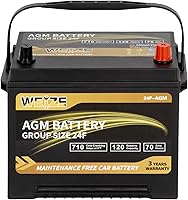
The Daakmax Platinum Group 24F Start-Stop AGM and Interstate Group 24 Flooded MT-24 show how those choices differ. They also have different group sizes, so treat them as examples of each design rather than interchangeable replacements.

 Best for conventional daily drivers
Interstate Group 24 Flooded (MT-24)
AGM battery vs regular battery: which should you choose?
Choose the type your vehicle specifies, then find a battery that meets its fit and power requirements. AGM is worth considering for an approved upgrade, but a compatible flooded battery remains a sensible replacement for many conventional cars.
AGM stands for absorbed glass mat, which holds electrolyte in glass mats between the plates. A regular car battery usually means a flooded lead-acid battery, with liquid electrolyte surrounding its plates.
Both designs store energy for starting and electrical use. AGM generally handles repeated discharge and recharge better, which helps explain its use in vehicles with frequent engine restarts.
Start by checking the manual, then confirm the old battery is the correct type. A previous replacement may have been wrong, so copying its label without checking the vehicle requirements can repeat the mistake.
Our guide to whether your car needs an AGM battery helps you identify those requirements. For a broader explanation of construction and care, see the AGM car battery buying guide.
AGM vs regular battery for start-stop cars
A start-stop car needs the battery design approved for its restart and charging system. Some use AGM, while others specify another design, such as enhanced flooded battery technology.
The Daakmax is designed for start-stop operation, but that description does not guarantee compatibility with every start-stop vehicle. Match the car's approved type, size and electrical requirements together.
If your car specifies AGM, keep AGM when replacing it. Disabling the start-stop feature does not change the battery requirements of the vehicle's charging system.
What do the starting power and capacity numbers mean?
CCA describes cold starting ability, reserve capacity describes a defined backup runtime, and amp-hours describe charge capacity. They answer different questions, so don't use one number as a substitute for the others.
The Daakmax has 710 CCA, 120 minutes of reserve capacity and 70Ah capacity. The Interstate has 600 CCA and 115 minutes of reserve capacity; an amp-hour figure is not established here.
Both are 12V batteries. The AGM's higher starting figure applies to this pair, not to every AGM and flooded battery you might compare.
Use CCA to meet the car's cold-start requirement
Cold cranking amps describe the current a battery can deliver under defined cold conditions. Choose a model that meets the vehicle's required minimum, especially when winter starts are part of your routine.
A larger CCA number does not correct the wrong terminal layout, an unsuitable charging setup or a weak starter. Our guide to what CCA means on a car battery explains how to use it when shopping.
Use reserve capacity to compare backup margin
Reserve capacity measures how long a battery can sustain a specified load under defined conditions. More reserve can help when electrical demand briefly exceeds charging output, but it is not a promise of engine-off accessory runtime.
The gap between these models is small compared with the importance of correct fit and type. Don't choose an incompatible battery for a few extra minutes of reserve.
Who should buy the Daakmax AGM, and who should skip it?
The Daakmax suits an approved Group 24F AGM application, especially a vehicle with start-stop operation or higher accessory loads. It makes sense when those demands are part of the car's design and the replacement meets its requirements.
Its maintenance-free construction needs no added water. Daakmax also describes a sealed, non-spillable design and claims greater vibration resistance than standard batteries.
Those features may appeal to drivers who travel on rough roads, but secure mounting still matters. A battery that moves in its tray can strain cables and connections regardless of its internal design.
Daakmax claims up to 2 times the cycle life of conventional batteries. Read that as a cycling claim, not a promise that it will last twice as many years.
Skip this model if your car needs a different size, terminal arrangement or battery technology. Also skip it for solar storage, trolling motors or other deep-cycle duties: Daakmax identifies it as a starting battery, not a deep-cycle model.
Who should buy the Interstate flooded battery, and who should skip it?
The Interstate MT-24 suits a conventional Group 24 replacement where flooded construction is approved. Interstate positions this model for hot to moderate climates, making that the clearest climate match for its intended use.
It is a practical choice for ordinary starting duties when its output meets the vehicle's needs. A car without start-stop or demanding engine-off electrical use may have little reason to change from its approved flooded design.
Skip it when the vehicle requires AGM or another specific technology. Its conventional construction also makes it the wrong choice if your goal is to meet an AGM requirement with a similar-looking battery.
Interstate describes 25 to 30 cycles at 80% depth of discharge. That figure is not a direct comparison with Daakmax's relative cycle-life claim, and neither figure is a reason to run a starting battery nearly flat.
Will Group 24 and Group 24F fit the same vehicle?
Do not assume Group 24 and Group 24F are interchangeable. Their different designations make terminal position and physical fit essential checks before ordering either battery.
The Daakmax measures 10.75 inches long, 6.81 inches wide and 8.98 inches high. It has tapered terminals described as left negative and right positive; compare the terminal diagram with your vehicle's cable arrangement.
The Interstate has top-post terminals. Confirm its dimensions and post layout against your vehicle's requirements before buying, including room for any protective cover.
Measure the tray, check overhead clearance and identify the hold-down style. If the vehicle uses a battery vent hose, confirm that the replacement supports the required connection.
Cables should reach their correct posts without stretching, twisting or crossing. Never rotate a battery or force a cable into place to make an unsuitable layout work.
Use your vehicle's year, make, model and engine when checking compatibility. Our explanation of what battery group size means helps you separate the size designation from the battery's electrical capacity.
Which type suits short trips, parked cars and accessory use?
Driving habits affect charging needs, but AGM cannot make up for a battery that stays undercharged. Repeated short trips, long parking periods and engine-off accessories can drain either design faster than the car replaces the energy.
Starting the engine uses stored charge. Short drives may not restore it fully, particularly when lights, fans, heated features and other loads are running.
An approved AGM can suit repeated cycling, but it still needs enough charging time. If your routine involves very short drives, consider a compatible external charger rather than relying on an occasional brief idle.
For a car parked for weeks, follow the vehicle's storage instructions. A suitable maintainer can help where approved, and its charge mode must match the battery type.
Music, lighting and other accessories used with the engine off consume starting reserve. Avoid treating either of these batteries as a power bank for long parked sessions.
If the car repeatedly loses charge despite normal use, investigate the cause before buying another battery. The guide to why a car battery keeps dying covers charging faults, electrical drains and other common causes.
How should you install and charge the replacement?
Follow the vehicle's replacement procedure and confirm charger compatibility before installation. Some cars require battery registration or coding, which helps their charging system account for the new battery.
Check that the new case is undamaged and the terminals match before removing the old battery. Plan for lifting, too: the Daakmax weighs 46 pounds.
Wear eye protection, remove metal jewelry and keep sparks or flames away from the work area. Keep tools from bridging a battery post to metal bodywork.
On a conventional negative-ground vehicle, removal normally starts with the negative connection, while reconnection ends with it. Follow the manual's sequence, designated connection points and any instructions for battery sensors.
Secure the hold-down, reconnect any required vent tube and fit the terminal covers. If the procedure involves unfamiliar sensors, access panels or coding, use a qualified shop.
Choose the correct external charging mode
Use a charger that supports your battery's chemistry and the vehicle's charging instructions. For AGM, select an approved AGM mode when the charger and battery guidance call for it.
Do not apply a high-voltage reconditioning or equalization mode unless the battery manufacturer expressly allows it. A charger having several modes does not make every mode suitable for both batteries.
Charging can produce gas, so use ventilation and keep ignition sources away. A sealed design still requires safe charging practices.
Care continues after installation
Keep the case clean, inspect accessible connections and check that the battery stays firmly mounted. Follow the vehicle's service guidance for corrosion or damaged cables rather than ignoring them until the next slow start.
Do not open the Daakmax or add water. For the Interstate, follow the model's care instructions instead of assuming all flooded batteries have user-serviceable caps.
Avoid repeated deep discharges, and recharge a depleted battery with suitable equipment. Jump-starting gets the engine running but does not mean the battery has recovered or can hold charge.
Is the AGM upgrade worth the total replacement cost?
AGM is worth the added expense when it meets a required specification or a clear, approved need. If your car allows either design and your driving is ordinary, compare the full replacement package before deciding.
Include installation, any required registration, warranty access and the used-battery return process. These practical details matter more than choosing a technology label by itself.
Daakmax provides a 3-year warranty and offers free replacement for quality issues during that period. Interstate provides a 24-month performance warranty from the date of purchase.
Check how to request warranty service and keep your receipt. A longer warranty and longer service life are different things, so don't use the warranty term as a lifespan forecast.
Interstate includes a refundable core deposit and directs buyers to return the used battery to an Interstate All Battery Center for the refund. Check that the return location is convenient before ordering.
Our guide to battery core charges explains how the return works. For another view of the technology trade-offs, read the AGM vs flooded battery comparison.
Which mistakes should you avoid before ordering?
The biggest mistake is buying by AGM label or starting power while overlooking compatibility. Use this short check before placing an order:
- Match the required technology. A conventional flooded battery cannot replace an AGM requirement simply because it fits the tray.
- Check the terminals. Similar case dimensions do not guarantee correct polarity or cable reach.
- Confirm installation needs. Include any required registration, coding or vent connection in your plan.
- Separate starting from deep-cycle use. Repeatedly draining a starting battery for accessories is the wrong use for these choices.
- Check the cause of failure. A replacement will not repair a charging fault or an electrical drain.
- Arrange the old battery's return. Plan safe transport and recycling before it becomes a storage problem.
For a complete shopping sequence, use our guide to how to choose a car battery. Keep the vehicle requirements beside you while comparing candidates so appealing extras don't distract from the basics.
AGM battery vs regular battery: make the final choice
Choose the Daakmax for a confirmed Group 24F AGM application with approved charging compatibility. Choose the Interstate for a confirmed Group 24 flooded application, particularly where its hot-to-moderate climate guidance matches your use.
If neither matches the required fit, choose another model rather than forcing a choice between these 2. Before ordering, write down the required type, group size, terminal layout and installation steps.
Finish the replacement by returning the old lead-acid battery through a suitable collection program. The Environmental Protection Agency's battery recycling guidance explains proper handling and recycling.
Frequently asked questions
Is an AGM car battery better than a regular battery?
AGM is a better fit when your vehicle requires it or approves it for frequent restarts and higher electrical loads; a regular flooded battery can be the right choice for ordinary starting duties. Match the vehicle's required type and fit before comparing starting power, reserve capacity or warranty.
Can I replace a regular battery with an AGM battery?
You can switch if your vehicle approves AGM and the replacement meets its size, terminal and electrical requirements; confirm charging compatibility before buying. Some vehicles also require battery registration or coding after replacement, so include that work in your installation plan rather than assuming every swap follows the same process.
Does an AGM battery last longer than a regular battery?
AGM can offer better cycle life, but service life in years depends on heat, charging, storage and driving habits. Daakmax claims up to 2 times the cycle life of conventional batteries; that comparison does not promise twice the calendar life or establish how these 2 models will age in your car.
Are AGM batteries maintenance-free?
The Daakmax AGM needs no added water or liquid, but it still needs proper charging and secure connections; keep its case clean and follow the vehicle's storage guidance. For the Interstate flooded battery, follow its own care instructions; flooded construction alone does not mean you should open it or add water.
What matters most when choosing a replacement car battery?
Start with the required battery type, group size, terminal layout and minimum cold cranking amps; check tray clearance, hold-down fit and any vent connection before ordering. Then compare reserve capacity, climate guidance and warranty, and confirm whether the vehicle needs battery registration or coding during installation.