9 Best Car Batteries for the Money (November 2026)
The best best car batteries for the money include the Weize Platinum Group 48 AGM for everyday commuters, the Weize Platinum Group 24F AGM for accessory-heavy daily driving, and the Weize Platinum Group 35 AGM for smaller-car replacements.
On this page (8 sections)
- How we chose car batteries for the money
- Compare the best car batteries for the money
- Which car battery suits your driving and installation?
- How do you choose the best car battery for the money?
- What should you check before replacing the old battery?
- How should you install and care for an AGM replacement?
- Which buying mistakes waste the most money?
- Which car battery is the best value for your vehicle?
The Weize Platinum Group 48 AGM is our best car battery for the money for compatible Group 48 vehicles, once Weize confirms its capacity and CCA. It combines reserve capacity with warranty coverage, but another group size may be the only correct choice for your car.
Value starts with compatibility. A battery that needs cable changes, won't clamp down or falls below the carmaker's requirements can turn a bargain into another replacement.
Use our guide to choosing a car battery to identify your requirements. Learn what a battery core charge is before comparing the total replacement cost.
Our picks at a glance
-
1

-
2
-
3
- 4
 Check it
Mighty Max MM-G35 Start-Stop (Group 35)
Best for prepared DIY installers - 5
 Check it
Autocessking Group 65 Start-Stop AGM
Best for larger battery trays - 6
 Best for stop-and-go commutersCheck it
- 7
 Check it
Autocessking Group 48 Start-Stop AGM
Best for occasional drivers - 8
 Check it
Daakmax Platinum Group 35 Start-Stop AGM
Best for rough-road driving - 9
 Check it
Mighty Max MM-H5 Start-Stop (Group 47)
Best for compact battery compartments
How we chose car batteries for the money
We ranked these batteries by vehicle fit, electrical specifications, useful features and clarity of warranty coverage. The scores favor a suitable replacement with clear buying requirements over broad promises about lifespan.
All 9 picks use AGM construction, so this selection is most useful if your vehicle requires AGM or supports an upgrade. It does not mean AGM is the cheapest sensible choice for every older car.
We also flagged conflicts that could change your decision. When capacity, case height or coverage is unclear, get confirmation for the exact model rather than choosing the more favorable number.
Compare the best car batteries for the money
Filter by group size first, then compare the compatible choices. A higher-ranked battery in the wrong group is not an alternative to the size your vehicle requires.
The table is a shortlist, not a fit guarantee. Check case dimensions, terminal layout, hold-down style and any vent connection before ordering.
| Product | Best for | Group size | Reserve capacity | Warranty | Our score |
|---|---|---|---|---|---|
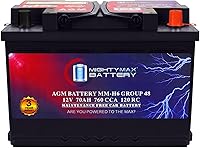
| Weize Platinum Group 48 AGM | everyday commuters | 48 | 120 minutes | 3 years | 8.4 |
| Weize Platinum Group 24F AGM | accessory-heavy daily driving | 24F | 3 years | 8.3 | |
| Weize Platinum Group 35 AGM | smaller-car replacements | 35 | 3 years | 8.2 | |
| Mighty Max MM-G35 Start-Stop (Group 35) | prepared DIY installers | 35 | 100 minutes | 7.9 | |
| Autocessking Group 65 Start-Stop AGM | larger battery trays | 65 | 3 years | 7.9 | |
| UPLUS Group 48 AGM | stop-and-go commuters | 48 | 3 years | 7.9 | |
| Autocessking Group 48 Start-Stop AGM | occasional drivers | 48 | 120 minutes | 7.8 | |
| Daakmax Platinum Group 35 Start-Stop AGM | rough-road driving | 35 | 3 years | 7.7 | |
| Mighty Max MM-H5 Start-Stop (Group 47) | compact battery compartments | 47 | 100 minutes | 7.5 |
Which car battery suits your driving and installation?
Choose within your required group size, then use your driving pattern and installation needs to break ties. The following picks cover different fits, with specific reasons to buy or skip each one.
Weize Platinum Group 48 AGM: Best for everyday commuters
- Group 48
- AGM design
- 120-minute reserve capacity
- 3-year warranty
A starting-battery choice for everyday drivers whose vehicles require Group 48 AGM. Resolve the conflicting capacity and CCA figures before ordering.
Pros
- 120-minute reserve capacity
- Designed for start-stop use
- Weize offers a 3-year warranty
Cons
- Capacity and CCA figures conflict
The Weize Platinum Group 48 AGM suits everyday drivers whose cars require this size and AGM construction. Its 120-minute reserve capacity and Weize's 3-year warranty make it the leading candidate here after its electrical specifications are resolved.
Weize gives conflicting figures of 70 Ah versus 60 Ah and 760 CCA versus 680 CCA. Ask Weize to confirm the exact model's capacity and starting rating against your vehicle's minimums.
The case measures 10.94 x 6.89 x 7.48 inches, with negative on the left and positive on the right. Check the terminal orientation from the same viewing direction as your current battery.
Choose it for a compatible daily driver, including a vehicle with start-stop requirements it meets. Skip it while the electrical figures remain unresolved, or if you need deep-cycle power for solar equipment or marine use.
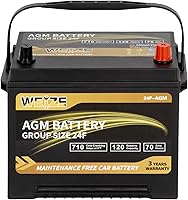
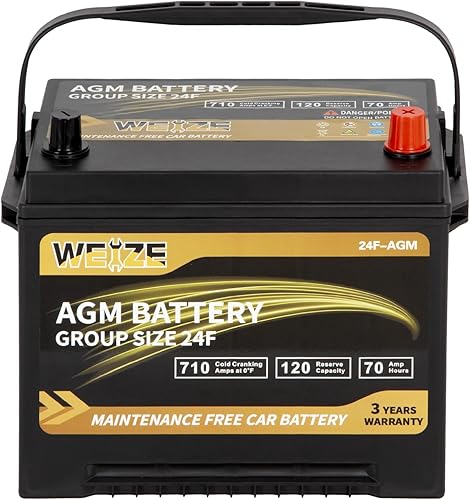
Weize Platinum Group 24F AGM: Best for accessory-heavy daily driving
- Group 24F
- 70 Ah capacity
- 710 CCA
- 3-year warranty
An AGM option for compatible Group 24F vehicles with higher electrical loads. Confirm overall height because Weize gives two different measurements.
Pros
- 70 Ah capacity
- Designed for higher electrical loads
- Weize offers a 3-year warranty
Cons
- Overall height needs confirmation
The Weize Platinum Group 24F AGM is the candidate here for a car that specifically needs this group and has higher electrical loads. Its 70 Ah capacity and 710 CCA give you clear electrical figures to compare with the carmaker's requirements.
Weize offers a 3-year warranty, but physical clearance needs attention. The case is 10.75 inches long and 6.81 inches wide, while the height figures conflict between 8.98 and 8.19 inches.
Confirm total height, including the posts, before committing to a tight compartment. The terminal arrangement is negative on the left and positive on the right.
Choose this battery when fit is confirmed and your vehicle calls for AGM. Skip it if clearance remains uncertain; a battery that almost fits can leave the positive terminal dangerously close to metal above it.
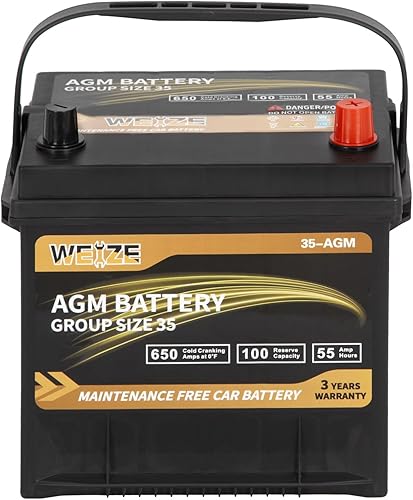
Weize Platinum Group 35 AGM: Best for smaller-car replacements
- Group 35
- 55 Ah capacity
- 650 CCA
- 3-year warranty
A replacement candidate for smaller cars that specifically require Group 35 AGM and meet its electrical limits. Confirm the height before buying.
Pros
- Designed for start-stop use
- 650 CCA
- Weize offers a 3-year warranty
Cons
- Two different height measurements
The Weize Platinum Group 35 AGM suits a smaller car only when the vehicle specifically accepts Group 35. Its 55 Ah capacity and 650 CCA must meet the required capacity and cold-starting specification, not merely resemble the old battery.
Weize offers a 3-year warranty and describes this model for start-stop systems and higher accessory loads. Those uses still depend on approval for your exact vehicle.
The case is 9.06 inches long and 6.89 inches wide, with negative on the left and positive on the right. Height needs confirmation because Weize gives both 8.82 and 8.03 inches.
Choose it as a straightforward AGM replacement once that measurement is settled. Skip it if your car requires more starting power or a different case, even if the smaller footprint seems easier to install.
Mighty Max MM-G35 Start-Stop (Group 35): Best for prepared DIY installers
- Group 35
- 55 Ah capacity
- 650 CCA
- 100-minute reserve capacity
A Group 35 alternative for installers who have checked the vehicle's hold-down and cable needs. Mounting screws are included, but warranty duration needs confirmation.
Pros
- 100-minute reserve capacity
- Sealed AGM construction
- Mounting screws included
Cons
- Conflicting warranty durations
- Wire harness and other mounting accessories excluded
The Mighty Max MM-G35 is worth comparing if you're installing a compatible Group 35 battery and already understand the vehicle's mounting needs. It provides 55 Ah, 650 CCA and 100 minutes of reserve capacity.
Its dimensions are 9.06 x 6.89 x 8.82 inches, with positive on the right and negative on the left. Mounting screws are included, but a wire harness and other mounting accessories are not.
Check whether your existing clamp and terminal connections can be reused in sound condition. Included screws do not replace a vehicle-specific hold-down or make a loose battery acceptable.
Confirm warranty duration before choosing it because Mighty Max gives both 1-year and 3-year terms. Skip this option if you need immediate installation and cannot resolve the coverage or obtain the hardware your car requires.
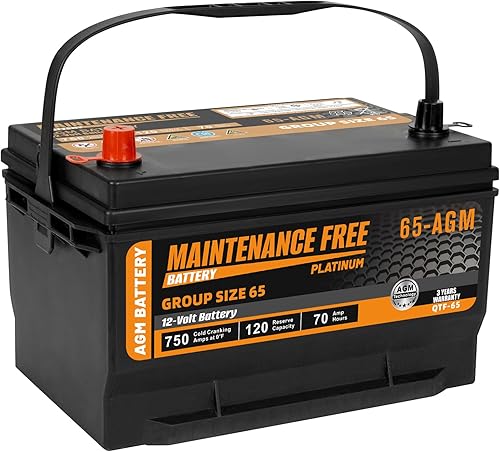
Autocessking Group 65 Start-Stop AGM: Best for larger battery trays
- Group 65
- 70 Ah capacity
- 750 CCA
- 3-year warranty
The option here for vehicles that require Group 65 and its left-positive terminal arrangement. Its larger case must match the tray and hold-down.
Pros
- 120-minute reserve capacity
- 750 CCA
- Autocessking offers a 3-year warranty
Cons
- Starting use only
- Left-positive layout must match the vehicle
The Autocessking Group 65 Start-Stop AGM serves vehicles that require the larger Group 65 case. Its 70 Ah capacity, 750 CCA and 120-minute reserve capacity make it a candidate when those figures satisfy the original requirements.
Autocessking offers a 3-year warranty. The case measures about 12.05 x 7.56 x 7.56 inches, with positive on the left and negative on the right.
That terminal arrangement deserves attention if you're comparing it with the other batteries here. Battery cables should reach their correct posts naturally, without stretching, crossing or pressing against sharp edges.
Choose it for the correct tray and cable layout, rather than as a way to squeeze a larger battery into another fit. Skip it for deep-cycle duties, including repeated discharge in a solar setup, because Autocessking specifies starting use.
UPLUS Group 48 AGM: Best for stop-and-go commuters
- Group 48
- 70 Ah capacity
- 760 CCA
- 3-year warranty
An alternative for compatible Group 48 cars used in stop-and-go traffic or frequent short trips. UPLUS offers a 3-year warranty and US support locations.
Pros
- Designed for start-stop systems
- 70 Ah capacity
- Support locations in California and Georgia
Cons
- Short trips can still leave a battery undercharged
The UPLUS Group 48 AGM is the alternative to compare for a compatible car used in stop-and-go traffic. UPLUS describes it for start-stop systems, frequent short trips and larger electrical loads.
It provides 70 Ah and 760 CCA, measures 10.98 x 6.81 x 7.51 inches, and has negative on the left and positive on the right. UPLUS offers a 3-year warranty and has support locations in California and Georgia.
Choose it when you want another Group 48 option with consistent capacity and starting figures to assess. Ask how warranty service works from your location before treating nearby support as a deciding benefit.
Skip it as a cure for chronic undercharging. Frequent engine starts and short drives can still use more charge than the charging system replaces, so your driving routine may also require an appropriate maintainer.
Autocessking Group 48 Start-Stop AGM: Best for occasional drivers
- Group 48
- 70 Ah capacity
- 760 CCA
- 120-minute reserve capacity
A starting-battery option for compatible cars parked between drives. Autocessking emphasizes low self-discharge, but parked vehicles may still need charge maintenance.
Pros
- 120-minute reserve capacity
- Maintenance-free AGM design
- Autocessking offers a 3-year warranty
Cons
- Terminal positions need confirmation
- Not intended for deep-cycle use
The Autocessking Group 48 Start-Stop AGM suits compatible cars that spend days or weeks parked between drives. Autocessking emphasizes low self-discharge, a useful feature for occasional use.
Its electrical specifications are 70 Ah, 760 CCA and 120 minutes of reserve capacity. The case measures about 11 x 6.9 x 7.5 inches, and Autocessking offers a 3-year warranty.
Confirm terminal positions before buying, since case size alone cannot guarantee cable compatibility. Also check the vehicle's venting arrangement if the battery sits in an enclosed compartment.
Choose it for starting a compatible occasional-use car, with a charge-maintenance plan for longer storage. Skip it for a house-battery role in an RV, boat or solar system; low self-discharge does not make a starting battery suitable for repeated deep discharge.
Daakmax Platinum Group 35 Start-Stop AGM: Best for rough-road driving
- Group 35
- 55 Ah capacity
- 650 CCA
- 3-year warranty
A compatible Group 35 alternative for drivers who prioritize vibration resistance. Daakmax emphasizes reinforced construction, while secure vehicle mounting remains essential.
Pros
- Sealed, spill-resistant design
- Daakmax emphasizes vibration resistance
- Daakmax offers a 3-year warranty
Cons
- Starting battery rather than deep-cycle power
- Requires a secure vehicle hold-down
The Daakmax Platinum Group 35 Start-Stop AGM is worth comparing for compatible vehicles driven on rough roads. Daakmax claims 18 times the vibration resistance of standard batteries, making vibration protection its main point of difference here.
It offers 55 Ah, 650 CCA and 100 minutes of reserve capacity, with a 3-year warranty from Daakmax. Dimensions are 9.06 x 6.89 x 8.82 inches, with negative on the left and positive on the right.
Choose it when its fit and electrical figures meet your car's needs and vibration resistance matters to your route. Treat the brand's comparison as a construction claim, rather than a forecast of years in service.
Skip it if the vehicle's hold-down is missing or damaged. Even a battery built to resist vibration needs secure mounting, and this starting model is not intended for deep-cycle solar or marine power.
Mighty Max MM-H5 Start-Stop (Group 47): Best for compact battery compartments
- Group 47
- 60 Ah capacity
- 680 CCA
- 100-minute reserve capacity
The Group 47 candidate for vehicles with the matching compact battery compartment. Resolve conflicting dimensions, terminal details and warranty duration before ordering.
Pros
- 680 CCA
- 100-minute reserve capacity
- Mounting screws included
Cons
- Dimensions and terminal details conflict
- Warranty duration needs confirmation
The Mighty Max MM-H5 is the Group 47 candidate for a vehicle with the matching compact battery compartment. It provides 60 Ah, 680 CCA and 100 minutes of reserve capacity.
Several fit details need resolution before buying. Mighty Max gives dimensions of both 9.53 x 6.88 x 7.48 inches and 10.71 x 13.58 x 8.07 inches, along with differing terminal descriptions.
Ask Mighty Max to identify the actual case dimensions and terminal connections for the MM-H5. Warranty duration also conflicts between 1 year and 3 years, so get the applicable coverage in writing.
Choose it only after those details are clear and match your vehicle. Skip it for an urgent replacement while fit is unresolved; mounting screws are included, but a wire harness and other mounting accessories are excluded.
How do you choose the best car battery for the money?
Match the vehicle's requirements before paying for extra capacity or features. Then compare the total installed cost, useful warranty coverage and how easily you can handle a replacement claim.
Start with fit when choosing the best car battery for the money
Use the owner's manual and a fit reference for your exact year, engine and trim. The current battery label is useful, but a previous replacement may have been the wrong size or type.
Check length, width, total height, terminal positions and the hold-down connection. Our car battery group size chart helps you understand common sizes, but the tray and vehicle requirements settle the choice.
An enclosed battery location may also need a vent tube connection. A sealed AGM design does not remove the need to follow the carmaker's venting instructions.
Keep the battery technology your vehicle requires
Keep AGM where the carmaker requires AGM. Start-stop operation and managed charging systems can place demands on a battery that a basic flooded replacement may not suit.
If the car accepts flooded batteries, compare the benefit of an AGM upgrade against the extra expense and any required vehicle settings. Read our AGM car battery guide and AGM versus flooded car batteries before changing technology.
Separate starting power from stored energy
CCA describes cold-starting ability, while amp-hours describe stored charge under defined conditions. Reserve capacity measures how long a battery can support a specified load before reaching a set voltage.
These figures answer different questions. A higher CCA number does not automatically mean longer parked accessory use, and reserve minutes are not a promise of the same runtime in your car.
Meet the manufacturer's minimum CCA, especially in cold climates. Our explanation of what CCA means on a car battery helps you compare starting figures without confusing them with capacity.
Compare useful coverage and the full replacement cost
A longer warranty matters only if the claim process works for you. Confirm replacement conditions, required proof, exclusions and who handles service before relying on the coverage.
Include installation, any required battery registration, needed hardware and the core-return process in your comparison. Our battery core charge explainer covers the old battery's return or recycling deposit.
Don't pay extra solely for the largest number on the label. Once two batteries meet your vehicle's needs, clear coverage and a practical return route can matter more than unused capacity.
What should you check before replacing the old battery?
Confirm that replacement addresses the problem, then prepare the correct tools and vehicle procedure. Slow cranking can come from a weak battery, poor connections, charging trouble or a starter fault.
If the battery repeatedly goes flat, investigate the cause before fitting another one. A new battery can also discharge if a light stays on, an accessory draws power while parked or the charging system has a fault.
Check for battery registration or coding requirements before disconnecting anything. Some vehicles need the replacement recorded so their charging management can account for the new battery's type or capacity.
Plan the lift and access route too. Several batteries here weigh around 40 lb or more, so a cramped engine bay may make professional installation the sensible choice.
How should you install and care for an AGM replacement?
Follow the vehicle's replacement procedure and use charging equipment suitable for AGM. Secure mounting, sound connections and enough recharge time help protect the money you spend.
Prepare the car and disconnect in the correct order
Park securely, switch the vehicle off and keep the key away from the car. Follow any required shutdown waiting period, wear eye protection and remove metal jewelry before working near the terminals.
For a conventional negative-ground vehicle, disconnect negative first, then positive. Keep tools from bridging a battery post to the body, and seek professional help if the vehicle requires unfamiliar steps.
Secure the battery before reconnecting it
Inspect the tray, cables and hold-down for corrosion or damage. Fit the replacement in the intended orientation, secure it to the vehicle's specified tightness and reconnect any required vent tube.
Reconnect positive first, then negative, following the vehicle procedure. Refit terminal covers and confirm that no cable is stretched, trapped or touching a moving part.
Complete any registration or reset steps the carmaker requires. Save the receipt, model information and warranty confirmation somewhere you can find them later.
Prevent repeated undercharging during short-trip use
Short trips may not replace all the energy used during starting and parked electrical activity. Combining errands into a longer drive can help, but repeated discharge calls for a check of the battery and charging system.
For long storage, use a compatible smart maintainer according to the battery and vehicle instructions. Low self-discharge describes the battery itself; the car can still draw power while parked.
Use the correct charger and keep the case closed
Choose the charging mode, voltage and current limits approved for the exact battery. Do not assume that every charger setting labeled for lead-acid batteries suits every AGM model.
These maintenance-free batteries do not need water added. Keep the top and terminals clean, inspect the hold-down periodically, and do not charge a battery that is frozen, swollen, leaking or visibly damaged.
Which buying mistakes waste the most money?
Wrong fit, unresolved specifications and ignoring the cause of discharge create the most avoidable replacement costs. Avoid these mistakes before choosing between brands.
- Buying by brand alone: A familiar name cannot make the wrong group size, terminal layout or battery technology compatible.
- Choosing by CCA alone: Starting power does not replace the need for correct capacity, mounting and charging compatibility.
- Assuming every warranty works alike: Duration, service location and claim conditions all affect its practical value.
- Using a starter battery for camping loads: Repeatedly running lights or other equipment until the battery is deeply discharged can shorten its life.
- Expecting AGM to fix an electrical fault: A parasitic drain or charging problem needs its own repair.
- Ordering before resolving conflicts: Confirm the exact model's unclear measurements or electrical figures while you can still choose another option.
Which car battery is the best value for your vehicle?
Choose the first compatible option with clear specifications and workable support. The best car battery for the money is the one that meets your car's needs without creating extra installation or return costs.
For Group 48, start with the Weize Platinum Group 48 AGM after its capacity and CCA are confirmed. Compare UPLUS for stop-and-go use or Autocessking for occasional driving, while keeping charge maintenance in mind.
For Group 24F or Group 35, the matching Weize model is the higher-ranked choice here once height is confirmed. Consider Mighty Max MM-G35 for an installation with known hardware needs, or Daakmax when vibration resistance matters.
Choose Autocessking for a compatible Group 65 vehicle. For Group 47, resolve the MM-H5's fit and warranty conflicts before committing; a lower-ranked compatible battery is more useful than a higher-ranked battery that cannot fit.
If you're replacing a battery that keeps going flat, first read why a car battery keeps dying. Finding the cause can prevent the same expense from returning with the next battery.
Our top 3 picks at a glance
-
1
-
2
-
3
Frequently asked questions
What makes a car battery good value for the money?
A good-value battery fits your vehicle, meets its electrical requirements and has clear warranty coverage. Compare the full replacement cost, including installation and core-return steps, rather than choosing by capacity alone.
Extra starting power is useful only after the required group size, terminal arrangement and battery type match.
Should I choose AGM or flooded for value?
Choose the battery type your vehicle requires, keeping AGM where the carmaker specifies it. An AGM upgrade can suit some vehicles, but the charging system and replacement procedure must support the change.
Our AGM vs flooded battery guide explains the differences before you compare compatible options.
How do I know which group size fits my car?
Start with the owner's manual and the current battery's label, then confirm dimensions, terminal positions and hold-down fit. Check the exact engine and trim because one vehicle model can have different battery requirements.
Our car battery group size guide explains why matching voltage alone is not enough.
Is a higher CCA battery always better?
Higher CCA can provide more cold-starting margin, but the replacement must first meet the carmaker's fit and battery-type requirements. Extra CCA does not mean more accessory runtime or cure an undercharging problem.
Read what CCA means on a car battery to separate starting power from storage capacity.
Can I buy a car battery online?
Yes, if you verify compatibility and understand delivery, returns and warranty service before ordering. Keep records of the model, purchase date and coverage, and plan how to recycle the old battery.
Our guide to buying a car battery online covers fit checks and practical delivery questions.