What Size Battery Does a Ford F-150 Take?
The right battery for a Ford F-150 matches its required group size, battery type, minimum CCA, and terminal layout. Confirm those requirements for your model year, engine, and equipment before considering these Group 65 AGM options.
On this page (8 sections)
- What size battery does a Ford F-150 take?
- How do you confirm the fit for your F-150?
- Does your F-150 need AGM or flooded?
- How much starting power and reserve capacity do you need?
- Which Group 65 battery for a Ford F-150 should you consider?
- What should you do before and during installation?
- How do you help the replacement last?
- How do you make the final Ford F-150 battery choice?
The right battery for a Ford F-150 matches the requirements for its model year, engine, and equipment. Confirm the required group size, battery type, minimum cold cranking amps, and terminal layout before ordering.
The 4 options below are Group 65 AGM batteries. They belong on your shortlist only after you confirm that this size and type suit your truck.
What size battery does a Ford F-150 take?
Your F-150 needs the battery group specified for its exact configuration. Use the owner’s manual or have a Ford dealer confirm the requirements by VIN rather than treating Group 65 as a universal answer.
The current battery label is a useful reference, but a previous replacement may be incorrect. Compare it with the truck’s requirements before buying the same thing again.
Group size describes a battery’s general case dimensions and terminal arrangement. Our guide to what battery group size means explains why that number matters.
Write down the required group, battery technology, and minimum CCA before shopping. That short checklist prevents you from choosing a battery that fits the tray but falls short electrically.
How do you confirm the fit for your F-150?
Match case dimensions, terminal positions, cable reach, and hold-down fit as well as the group number. The replacement must sit securely without stretching cables or bringing terminals too close to metal above them.
Check these points before ordering:
- Length and width fit inside the tray.
- Height leaves enough clearance above the terminals.
- Positive and negative posts match the cable positions.
- The original hold-down can secure the case correctly.
- Any required vent connection is compatible.
Terminal orientation can be confusing when batteries are photographed from different sides. Compare the actual positive and negative markings with the cable positions in your truck.
Never force a cable across the battery to reach the opposite post. A replacement that needs strained cables or an improvised hold-down is the wrong choice.
The car battery group size chart helps you compare common sizes. Your truck’s requirements remain the final reference.
Does your F-150 need AGM or flooded?
Use the battery type your truck requires, and keep AGM if AGM is required. Before changing a flooded battery to AGM, confirm that the replacement suits the truck’s charging system and equipment.
AGM holds electrolyte in glass fiber mats and does not need routine water additions. Its sealed design still needs correct charging, secure mounting, and clean connections.
Start-stop equipment matters because repeated engine restarts place different demands on a battery. Disabling start-stop does not mean a different battery type is suitable.
For more help with that choice, read AGM vs. flooded car batteries. If you need a broader checklist, our guide to how to choose a car battery connects fit, starting power, and battery technology.
How much starting power and reserve capacity do you need?
Choose at least the minimum CCA your F-150 requires, then compare reserve capacity and amp-hours within compatible options. All 4 batteries here have 750 CCA, so none belongs on your shortlist if your truck requires more.
CCA describes cold-starting ability. A higher number cannot compensate for the wrong group size, reversed terminals, or an unsuitable battery type.
Amp-hours describe stored charge, while reserve capacity describes how long a battery can support a standardized load. Neither figure tells you exactly how long your truck can run lights, audio, or other accessories with the engine off.
Cold weather makes starting power especially relevant, but short trips and long periods parked also affect charge level. Read what CCA means on a car battery if you need help interpreting the number.
Which Group 65 battery for a Ford F-150 should you consider?
Compare these 4 Group 65 AGM options only after confirming fit. Their shared starting-power figure means the decision rests on case measurements, capacity, intended use, and warranty support.
Weize battery for Ford F-150 owners comparing capacity
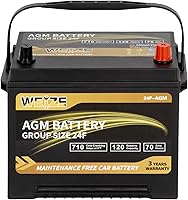
The Weize Platinum Group 65 AGM suits buyers who want 70 Ah capacity and 120 minutes of reserve capacity in a compatible starting battery. Weize backs it with a 3-year warranty.
Its fit guidance gives a case size of 12.05 x 7.56 x 7.56 in and tapered posts with positive on the left and negative on the right. Allow for the full dimensions rather than relying on a rounded measurement.
Choose it if those measurements match your truck and you want a stated reserve-capacity figure for comparison. Its 46 lb weight also matters if you plan to lift it into a tall engine bay.
Skip it if your goal is to power camping equipment through repeated deep discharges. Weize identifies this as a starting battery, not a deep-cycle battery for solar or marine use.
Interstate for buyers considering pure-lead AGM
The Interstate Group 65 AGM suits buyers who specifically want a pure-lead AGM design. Its MTX-65 model has 68 Ah capacity, weighs 45 lb, and measures 12.06 x 7.56 x 7.44 in.
That case is slightly lower than the other options’ full fit measurements. Check the entire installation, including post height and hold-down engagement, before treating that difference as useful clearance.
Interstate describes the battery as maintenance-free, spill-proof, and vibration resistant. Those features suit normal vehicle use, but they do not remove the need to check charge level and terminal condition.
Choose it if the pure-lead construction matters to you and its fit checks out. Skip it if terminal orientation remains unclear or you need a stated reserve-capacity figure before deciding; confirm those details first.
Daakmax for compatible start-stop trucks
The Daakmax Platinum Group 65 Start-Stop AGM suits buyers replacing a compatible start-stop starting battery. It has 70 Ah capacity, 120 minutes of reserve capacity, and a 12.05 x 7.56 x 7.56 in case.
Its tapered terminals place positive on the left and negative on the right. Daakmax backs it with a 3-year warranty and promises replacement for qualifying quality issues during that period.
Choose it when the fit matches and you want to compare its warranty support with the other options. Check how a claim is handled and keep your proof of purchase.
Skip it for repeated engine-off power use that deeply drains the battery. Daakmax specifically identifies it as a starting battery rather than a deep-cycle option, so its accessory-load suitability does not make it a camping power bank.
Autocessking for trucks parked between trips
The Autocessking Group 65 Start-Stop AGM is worth considering for a compatible truck used less often. Autocessking says its low self-discharge helps reduce charge loss during storage.
It has 70 Ah capacity and 120 minutes of reserve capacity, with a 3-year warranty. Fit guidance gives dimensions of 12.05 x 7.56 x 7.56 in and tapered posts with positive on the left.
Choose it if its fit matches and your truck regularly sits between trips. Confirm exact clearance if the tray or cover leaves little room, since rounded case measurements also appear for this model.
Skip it if you expect storage performance to overcome a constant electrical drain. A parked truck can still discharge a battery through connected accessories or an electrical fault, and Autocessking excludes deep-cycle applications.
What should you do before and during installation?
Confirm the replacement procedure for your exact truck before disconnecting anything. Ask whether battery monitoring needs a reset or another service step after replacement, and follow Ford’s instructions.
Park securely, switch everything off, and keep the key away from the vehicle. Wear eye protection, remove metal jewelry, and keep tools from bridging a terminal to nearby metal.
For a conventional negative-ground system, removal generally starts with the negative connection, followed by positive. Installation generally reverses that order, but follow the truck’s procedure wherever it differs.
Inspect the tray, cables, and hold-down while the old battery is out. Clean corrosion safely and repair damaged connections before fitting the replacement.
Secure the battery and tighten connections to the specified torque. Do not overtighten terminals, and arrange help lifting if you cannot safely handle the battery at engine-bay height.
How do you help the replacement last?
Keep the battery charged, securely mounted, and free of loose connections. Maintenance-free means no routine water additions, not that the battery can be ignored.
Frequent short trips may leave too little time to recover the energy used during starting. For extended parking, consider an AGM-compatible maintainer used according to its instructions.
Avoid running lights, audio, or chargers for long periods with the engine off. A starting battery is built around engine starts, and repeated deep discharge can shorten its life.
If the replacement keeps losing charge, investigate the cause instead of buying another battery. Our guide to why a car battery keeps dying covers charging faults, electrical drains, and driving patterns.
How do you make the final Ford F-150 battery choice?
Buy a battery for your Ford F-150 that passes every fit and electrical check before choosing between brands. If Group 65 AGM is wrong for your configuration, skip all 4 options.
Choose Weize for its stated capacity and reserve figures, or Interstate if you prefer its pure-lead AGM design. Consider Daakmax for a compatible start-stop replacement, and Autocessking when reduced self-discharge during parking is relevant.
The close specifications make warranty support and exact fit useful deciding factors. For alternatives after confirming your required size and type, see our best car batteries for trucks guide.
Frequently asked questions
What size battery does a Ford F-150 take?
Your F-150 needs the battery group specified for its model year, engine, and equipment; check the owner’s manual or have a Ford dealer confirm the requirement by VIN. Then match the replacement’s dimensions, terminal layout, battery type, and minimum CCA rather than assuming every F-150 takes Group 65.
Can I use an AGM battery in my Ford F-150?
Use AGM if your F-150 requires it, and confirm charging-system compatibility before changing from flooded to AGM; start-stop equipment can affect the required battery type. A matching case size alone is not enough, so check the manual or ask a Ford dealer about your truck’s exact configuration.
How do I check if a Group 65 battery will fit?
Confirm that your truck calls for Group 65, then compare case dimensions, terminal positions, cable reach, and hold-down fit; check clearance above the terminals as well as around the case. The replacement must also meet the required battery type and minimum CCA; physical fit is only part of compatibility.
What CCA should a Ford F-150 battery have?
Choose at least the minimum CCA specified for your F-150’s exact configuration; all 4 batteries discussed here have 750 CCA, so none is suitable if your truck requires more. Extra CCA cannot make up for the wrong battery group, terminal arrangement, or battery type.