Can You Charge an AGM Battery With a Regular Charger?
Yes, you can charge an AGM battery with a regular charger, but only if the charger has an AGM or sealed lead-acid setting and the correct voltage. A basic trickle charger without those settings can undercharge or overcharge an AGM, so check the charger's label first.
On this page (8 sections)
- Can a regular charger handle an AGM battery?
- What type of charger is safe for an AGM battery?
- When is a regular charger unsafe for AGM?
- How do you charge an AGM battery with a regular charger?
- Can you leave a regular charger connected to an AGM?
- Which chargers suit an AGM battery best?
- How do you check the charge when you're done?
- Which charger should you buy for an AGM?
Yes, you can charge an AGM battery with a regular charger, but only if the charger has an AGM or sealed lead-acid setting and the correct voltage. A basic trickle charger without those settings can undercharge or overcharge an AGM, so check the charger's label first.
AGM batteries are still lead-acid inside. The difference is that the acid is soaked into glass mats rather than sitting as liquid.
That changes how the battery likes to be charged, which is where "can I charge an AGM battery with regular charger" gets a conditional answer.
Can a regular charger handle an AGM battery?
A regular charger works on an AGM battery when its charge profile matches sealed lead-acid batteries. Many modern smart chargers offer an AGM mode, a sealed setting or a gel/AGM switch.
If yours has one, use it.
The setting matters because AGM batteries have a lower internal resistance and less electrolyte to lose. They charge faster than flooded batteries and reach full voltage sooner.
A charger tuned for flooded batteries can push past that point.
The mismatch is worst with old transformer chargers that keep charging as long as they're plugged in. These have no shutoff and no AGM awareness.
A smart charger with automatic detection and a float stage is the safer match.
Voltage is the other check. A 12V AGM needs a charge voltage in the 14.4 to 14.7 volt range during the bulk stage.
A charger that's designed for a different battery chemistry won't hit those numbers correctly.
What type of charger is safe for an AGM battery?
A smart charger with an AGM or sealed lead-acid mode and automatic shutoff is safe. Look for three things on the label: AGM support, automatic charge control and a float or maintenance stage.
Smart chargers sense the battery's state and adjust current as it fills. They drop to a lower maintenance voltage once the battery is full.
That prevents the gassing and heat that damage AGM batteries.
AGM chargers also often include temperature compensation. A cold battery needs a slightly higher charge voltage, and a hot one needs less.
The charger's internal sensor adjusts for this, which protects the battery across seasons.
The agm battery vs regular battery comparison explains why the charge profile differs in the first place. The short version: AGM batteries are sealed and can't be topped up with water, so every overcharge is permanent.
When is a regular charger unsafe for AGM?
A regular charger is unsafe for AGM when it lacks an AGM setting and can't stop charging on its own. The main risk is overcharging, which dries out the glass mats and shortens battery life.
The second risk is an aggressive charge rate. A very high-amp charger pushes a lot of current into a small AGM quickly.
That builds heat inside a sealed case where it can't escape easily.
Old trickle chargers with a fixed low output are a milder problem. They rarely overcharge, but they can leave an AGM undercharged if the voltage never reaches the full mark.
An undercharged AGM sulfates over time.
Check the charger's manual before connecting anything. If the manual only names flooded batteries and has no AGM or sealed setting, treat that charger as a poor match for your AGM.
How do you charge an AGM battery with a regular charger?
Connect the charger with the AGM setting selected, then let it run through its full cycle. The steps are the same as any 12V lead-acid charge, with a few AGM-specific checks.
- Confirm the charger's output matches the battery's voltage: 12V for most cars and trucks.
- Select the AGM or sealed lead-acid mode if the charger offers one.
- Connect the positive clamp to the positive terminal, then the negative clamp to the negative terminal or the ground point named in your vehicle's manual.
- Plug the charger in and let the automatic cycle finish.
- Disconnect in reverse order and check the resting voltage before refitting the battery.
Keep the charger and battery in a ventilated spot while charging. Even sealed AGM batteries can vent small amounts of gas under charge.
Don't charge a battery that's hot to the touch or visibly swollen.
For a battery that's already flat, a low-amp maintainer will be slow. That's the point of the product boxes below: they match the job to the charger.
The NOCO GENIUS5 covers 6V and 12V lead-acid batteries, including AGM, gel and flooded types. NOCO says it can charge batteries from as low as 1 volt, and its Force Mode handles completely dead ones.
The integrated thermal sensor adjusts the charge to ambient temperature.
That makes it the better pick when your AGM is already flat and you need recovery, not just topping up. Its 5 amp output also fills a typical car AGM faster than a small maintainer.
Can you leave a regular charger connected to an AGM?
You can leave an AGM on a smart charger in float mode for long periods, but not on a basic charger without shutoff. Float charging is how maintainers keep stored batteries healthy.
Float mode holds the battery at a steady low voltage once it's full. It replaces the small amount of self-discharge a battery loses while sitting.
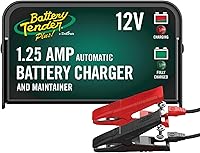
The Battery Tender Plus is built around this idea, with a 4-step program and a two-color LED that shows charge state.
Battery Tender says the Plus is a fit for AGM batteries in performance cars and other infrequently driven vehicles. It uses fused ring terminals and alligator clips, so you can wire it to a stored battery and leave it connected.
The quick disconnect harness makes it easy to unhook when you drive.
A basic regular charger with no float stage shouldn't stay connected. It keeps feeding current and cooks the battery.
If your charger's light stays on "charging" indefinitely, unplug it once the battery reads full.
Which chargers suit an AGM battery best?
The best match for an AGM is a smart charger with an AGM profile and temperature-aware charging. Three options cover most jobs: long-term storage, recovery and cold weather.
Best for long-term AGM maintenance
The Battery Tender Plus is the pick for a car or motorcycle AGM that sits for weeks. Its 1.25 amp output and 4-step program are designed for maintenance rather than fast recovery.
It's a good fit for seasonal vehicles and garage-kept batteries.
Best for reviving a flat AGM battery
The NOCO GENIUS5 is the pick when the AGM has dropped low. It covers 6V and 12V lead-acid batteries and its Force Mode can charge a completely dead battery.
It also includes a desulfation function for neglected batteries.
Best for cold-weather AGM charging
The CTEK MXS 5.0 is a fully automatic 4.3 amp charger with an 8-step program. It's rated for 12V lead-acid and AGM batteries, and CTEK says it's built for cold weather.
Its reconditioning function can help underperforming batteries.
The CTEK is splash, dust, spark and shock proof and meets IP65, so it handles a garage or marine setting. Its float/pulse charging lets you leave it connected for months.
How do you check the charge when you're done?
Read the resting voltage after the charger finishes and the battery sits for a while. A fully charged 12V AGM typically rests around 12.8 volts or a little above.
Don't read the voltage right after unplugging, because the surface charge gives a falsely high number. Wait a few hours, or switch on a small load briefly, then measure again.
You can use a multimeter or a dedicated tester. Our guide to how to test a car battery at home walks through the steps.
If you want a tester that gives a quick verdict, compare the options in our car battery tester roundup.
If the AGM won't hold voltage after a full charge, the battery itself may be near the end of its life. A charger can't fix a battery that's already failed internally.
Which charger should you buy for an AGM?
The decision comes down to what you're doing with the battery. Pick the Battery Tender Plus for storage, the NOCO GENIUS5 for recovery and the CTEK for cold climates.
All three have AGM support, so none needs a separate "regular charger" workaround.
If your current charger has an AGM or sealed setting, use it and save the money. If it's an old unit with no AGM mode, replace it before you connect it to a sealed battery.
That's the safe answer to "can I charge AGM battery with regular charger": only when the charger is built for AGM.
The best charger for AGM battery guide covers more models if none of these fits your setup. For a broader look at battery types, the agm vs regular battery explainer is the next read.
Frequently asked questions
Can a normal car battery charger ruin an AGM battery?
It can if it's an old non-automatic charger that keeps pushing current after the battery is full. AGM batteries don't tolerate overcharging well.
Use a charger with an AGM setting and automatic shutoff or float mode instead.
What voltage should an AGM battery charge at?
Most 12V AGM batteries charge at roughly 14.4 to 14.7 volts in the main charge stage. Float or maintenance voltage is lower, around 13.2 to 13.6 volts.
Always follow the battery maker's numbers.
How long does it take to charge an AGM battery?
It depends on charger amperage and how flat the battery is. A small 1.25 amp maintainer can take a full day or more to bring a deeply discharged AGM back up.
A 4 to 5 amp charger usually recovers one faster.
Can I jump-start an AGM battery?
Yes, AGM batteries can be jump-started like any 12V lead-acid battery. Connect the leads in the standard order and let the engine run afterward so the alternator can recharge the battery.
Is an AGM charger different from a regular charger?
An AGM-specific charger uses a charge profile tuned for sealed lead-acid batteries, including temperature compensation and a safe float stage. Many modern regular chargers offer an AGM mode, so the gap is smaller than it used to be.