AGM vs Lead-Acid Battery Charging: What Differs? (November 2026)
An AGM battery needs a lower, voltage-regulated charge than a flooded lead-acid battery, and a smart charger with an AGM setting is the safe way to deliver it. Flooded batteries tolerate a higher finish voltage and need water checks; AGM batteries are sealed and can be damaged by overcharging.
On this page (9 sections)
- Quick verdict: which charger fits which battery?
- AGM vs lead-acid charging side by side
- How charge voltage changes for a sealed AGM battery
- How charge current and speed differ in practice
- Charger settings: AGM mode vs flooded mode
- Maintenance and storage: where the split widens
- Safety and location when charging either type
- Who should buy which charger?
- The verdict: match the charger to the battery chemistry
An AGM battery needs a lower, voltage-regulated charge than a flooded lead-acid battery, and a smart charger with an AGM setting is the safe way to deliver it. Flooded batteries tolerate a higher finish voltage and need water checks; AGM batteries are sealed and can be damaged by overcharging.
This agm battery vs lead acid charging comparison walks through the voltage limits, current handling, maintenance and charger settings that actually differ.
Both are lead-acid batteries at heart. An AGM battery holds its acid in a glass mat, so it is sealed and spill-proof, while a flooded battery keeps liquid acid you can top up.
That one design change drives most of the charging differences.
 Best for mixed battery types
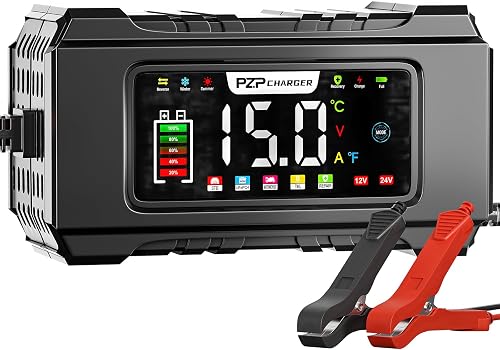
PZ.P 15-Amp 12V/24V Smart Battery Charger

Quick verdict: which charger fits which battery?
A smart charger with an AGM profile is the safe default for both battery types, and the PZ.P 15-amp is the better all-round pick for a mixed garage. The Huiaipaic 20-amp is the faster option when bulk charging speed matters more than a smaller footprint.
The PZ.P unit lists AGM, GEL, SLA and flooded support at 12V 15A and 24V 8A. It runs a 9-stage charge and then holds a trickle/float mode.
That float stage is what protects an AGM battery in storage.
The Huiaipaic unit pushes 12V 20A and 24V 10A, so it fills a large battery faster. It also covers AGM and flooded types.
Its 300W output and pulse repair mode make it the pick when a battery has sat flat for a while.
Neither charger is AGM-only. That matters, because many homes keep a flooded battery in the truck and an AGM in the daily driver.
One charger that can switch profiles covers both without a second purchase.
If you mainly want to know whether a battery still holds charge, a car battery tester is the tool to pair with either charger. Charging and testing are separate jobs.
AGM vs lead-acid charging side by side
The main split is voltage ceiling and water maintenance: AGM stays sealed and charges to a lower finish voltage, while flooded batteries accept more and need topping up. The table below lines up the practical differences.
| Point | AGM battery | Flooded lead-acid battery |
|---|---|---|
| Case | Sealed, spill-proof | Vented, with removable caps |
| Finish charge voltage | Lower, often mid-14s | Higher, often up to about 14.8V |
| Water checks | None possible | Needed regularly |
| Charge acceptance | Faster for its size | Slower, gassing at high voltage |
| Overcharge risk | High, damage is permanent | High, but water loss can be corrected |
| Best charger setting | AGM or sealed | Flooded or standard |
The voltage numbers above are typical ranges. Your battery label is the authority, since AGM makers set their own limits and some sealed batteries sit outside the usual window.
Charge acceptance is where AGM often wins in daily use. Its tightly packed glass mat lets current spread evenly across the plates, so it can take a bulk charge quickly without the acid stratifying the way it can in a tall flooded cell.
That speed only helps within the battery's own limit. Pushing a higher current than the maker allows heats the plates and can vent a sealed case.
A smart charger that reads the battery first avoids that.
How charge voltage changes for a sealed AGM battery
AGM batteries want a bulk charge around the mid-14s and a float near 13.2 to 13.8 volts, and going above that can vent the case. Flooded batteries often take a finish voltage up to about 14.8 volts because their caps let gas escape and water be replaced.
This is the first thing that separates the two types on a charger. A basic flooded-only charger ends its charge at the higher flooded figure.
Connect that to an AGM battery and the extra volts push gas out through the sealed case.
The glass mat holds only a set amount of electrolyte. When gas escapes, that liquid cannot be replaced, because there are no caps to open.
The lost electrolyte dries the mat and raises internal resistance, and the battery loses capacity for good.
A smart charger with an AGM profile clamps the voltage to the sealed limit. The PZ.P unit adjusts its stages and includes temperature compensation, so a cold battery is not overcharged to the same voltage as a warm one.
The Huiaipaic unit reads battery voltage and sulfation before choosing its current.
Why temperature matters more for AGM
Cold slows the chemical reaction inside any lead-acid battery, so the charger has to lift voltage to push current in. A hot battery needs less.
An AGM case holds heat closer to the plates than a vented flooded case, so an uncompensated charger can overshoot on a warm day.
Both chargers here address that in their own way. The PZ.P unit shows internal temperature and runs summer and winter modes.
The Huiaipaic unit also carries summer and winter modes and adjusts current for harsh voltage conditions.
How charge current and speed differ in practice
AGM batteries usually accept a higher bulk current for their size, so a 20-amp charger fills one faster, but the battery maker's current limit still rules. Flooded batteries charge more slowly at the top end because they gas as they approach full.
Bulk current is the number that decides how long the first part of the charge takes. The Huiaipaic unit delivers 12V 20A on a 12V battery and 10A on 24V.
The PZ.P unit runs 12V 15A and 24V 8A. On a large truck or marine battery, that gap shortens a charge noticeably.
A small lawnmower or motorcycle AGM battery is a different story. It has less plate area to absorb current, so the bulk stage finishes quickly and the charger rolls into absorption and float.
The float stage matters more than the peak amps for a battery you store through winter.
The Huiaipaic unit's 300W output and pulse repair mode suit a battery that has sat flat. Pulse repair sends short high-frequency pulses to break up sulfation on the plates.
The PZ.P unit does the same job with its one-click pulse repair, which detects sulfation and acid stratification.
Neither repair mode revives a totally dead battery. Both makers say so plainly.
Treat repair as a way to recover a neglected but still usable battery, not a resurrection tool.
Charger settings: AGM mode vs flooded mode
Pick the AGM or sealed setting for a glass-mat battery and the flooded or standard setting for a vented one, because the finish voltage is different. Getting this wrong is the most common way people damage an AGM battery at home.
Many smart chargers label the AGM setting as "AGM," "sealed" or "SLA." The flooded setting often reads "standard," "flooded" or "wet."
Some chargers, like the PZ.P and Huiaipaic units here, list AGM, GEL, SLA and flooded types and adjust the stages for each.
A plain automotive charger without profiles is a risk. It assumes a flooded battery and charges to the flooded voltage.
That is fine for a vented battery you can top up and wrong for a sealed one you cannot.
If your charger has only one setting and your battery is AGM, read the voltage printed on the case. When the charger's finish voltage sits above the AGM limit, use a different charger.
A best AGM car battery pick usually lists its required charge voltage in its specs, which helps you match the two.
Maintenance and storage: where the split widens
Flooded batteries need water checks and terminal cleaning, while AGM batteries are sealed and need only a top-up charge in storage. That is the biggest day-to-day difference in agm battery vs lead acid charging.
On a flooded battery, you check the electrolyte level and add distilled water when the plates start to show. You also clean terminals and watch for acid residue around the caps.
These are simple jobs, but they need doing on a schedule.
An AGM battery needs none of that. You cannot open it, so there is no water to add.
What it does need is a periodic top-up charge when it sits unused. A smart charger's trickle/float mode handles that.
The PZ.P unit is built for this. Its 9-stage process ends in a trickle/float mode, so you can leave it connected through winter and holiday storage.
The Huiaipaic unit offers the same final protection, with a trickle charge that holds the battery once full.
Which type ages better in storage?
Both types self-discharge when left idle. AGM batteries typically hold charge longer than flooded ones, but neither likes sitting flat for months.
Sulfation builds on the plates either way and cuts capacity.
The fix is the same for both: keep the battery on a maintainer or top it up every few weeks. This is also where how long does a car battery last depends more on care than on type.
A well-kept AGM and a well-kept flooded battery both outlast one left to die.
Safety and location when charging either type
Charge in a ventilated space and keep sparks away, and remember that a sealed AGM still vents gas under charge. The sealed label does not make an AGM battery safe to charge in a closed, unventilated cabinet.
Flooded batteries vent hydrogen while charging. AGM batteries hold the acid in glass mats but still release gas through a pressure valve when pushed hard.
That is another reason a voltage-regulated charger matters, since it keeps the gas release to a minimum.
Both chargers here carry protection features. The PZ.P unit lists reverse polarity protection, overcurrent protection, overvoltage protection, short-circuit prevention and fireproof materials.
The Huiaipaic unit lists overcharge, overvoltage, overtemperature, spark and short-circuit protection with a built-in controller.
Keep the charger off wet floors and away from fuel. Run the cables so they do not cross walkways or sit across hot engine parts.
The PZ.P unit's 6.7ft cable helps reach a battery in a tight engine bay without stretching.
Who should buy which charger?
Buy the PZ.P 15-amp if you keep both AGM and flooded batteries and want one charger with clear AGM support. Buy the Huiaipaic 20-amp if bulk speed is the priority.
The PZ.P unit suits a mixed garage. It covers 12V and 24V packs across LiFePO4 and lead-acid types, including AGM, GEL, SLA and flooded.
The color screen shows voltage, current, internal temperature, charge percentage and summer or winter mode. A 15-amp output is plenty for a car or SUV battery and gentler on a smaller motorcycle or lawnmower AGM.
The Huiaipaic unit suits anyone charging large truck, marine or RV batteries who wants the bulk stage finished quickly. Its 20-amp 12V output and 10-amp 24V output beat the PZ.P unit's current, and its 300W transformer keeps efficiency up.
It still covers AGM and flooded types, so it is not locked to one chemistry.
If your only battery is a small AGM motorcycle battery, either unit works but the PZ.P's lower peak current is the safer match. If you run a fleet or a boat with several large batteries, the Huiaipaic unit's speed saves time.
For anyone unsure which type is in the car, the AGM battery guide explains how to tell them apart by the case and label.
The verdict: match the charger to the battery chemistry
For most readers the safe answer to agm battery vs lead acid charging is a smart charger that lists AGM as a separate profile, because it protects the sealed battery without asking you to memorize voltages. The PZ.P 15-amp is our overall pick for a mixed set of batteries.
Its AGM support, temperature compensation and float mode cover the differences that matter most.
The Huiaipaic 20-amp wins when speed is the goal. Its 20-amp 12V output and pulse repair mode make short work of a flat truck or marine battery.
Just make sure the battery can accept the current before you connect it.
The decision rule is simple. Pick the PZ.P for everyday charging and storage across mixed battery types.
Pick the Huiaipaic when you need to fill a large battery fast. In both cases, set the charger to the AGM profile for a glass-mat battery and the flooded profile for a vented one.
That one setting is the whole point of the comparison. AGM and flooded batteries share the same basic chemistry but not the same charge limits.
A charger that knows the difference keeps both types healthy.
Our score weighs specs, features and fit with what the keyword's searcher wants. Both units handle the charging side well; the PZ.P edges ahead for a mixed battery collection, and the Huiaipaic edges ahead for raw speed.
Frequently asked questions
Can I charge an AGM battery with a regular lead-acid charger?
Only if the charger has an AGM mode or a low enough finish voltage. A plain flooded-battery charger can push AGM cells past their safe limit.
Check the charger's stated voltages for AGM before connecting it to a sealed battery.
What charge voltage does an AGM battery need?
Most 12V AGM batteries want a bulk charge in the mid-14s and a float around 13.2 to 13.8 volts. Flooded batteries often accept a higher finish voltage.
Follow the voltage printed on your battery label, since brands differ.
Is charging an AGM battery faster than a lead-acid one?
Not usually. AGM batteries often accept a slightly higher bulk current for their size, but the safe limit is set by the battery maker.
A higher-amp charger speeds both types only when the battery can take the current.
Do AGM batteries need a trickle charger?
Yes, for storage. An AGM battery left idle loses charge and sulfates over time.
A smart charger with a float mode keeps it topped up and is the simplest way to protect a spare or seasonal battery.
What happens if I overcharge an AGM battery?
Overcharging an AGM battery can vent gas, dry out the glass mat and shorten its life. Sealed AGM cases have no caps for adding water, so the damage cannot be undone.
A voltage-regulated smart charger prevents this.
Can a smart charger handle both AGM and flooded batteries?
Yes, many smart chargers list AGM, GEL, SLA and flooded types and adjust the charge stages for each. The PZ.P 15-amp and Huiaipaic 20-amp units both cover these types across 12V and 24V packs.


