AGM vs Gel Battery: Which Is Better? (November 2026)
Pick AGM for engine starting and gel for vibration-heavy or deep-cycle use. In this AGM battery vs gel battery comparison, the gel pick here (Chrome S Pro iGel YTX14-BS) wins overall for most readers, while the ACDelco Gold 94RAGM is the better car and truck choice.
On this page (8 sections)
- AGM vs gel battery: the two side by side
- Which type handles vibration better?
- Which one starts an engine in the cold?
- How does each type handle charging?
- Which one lasts longer?
- Is a sealed lead acid battery vs AGM battery the same question?
- Who should buy which?
- The verdict: gel for most readers, AGM for the garage
Pick AGM for engine starting and gel for vibration-heavy or deep-cycle use. In this AGM battery vs gel battery comparison, the gel pick here (Chrome S Pro iGel YTX14-BS) wins overall for most readers, while the ACDelco Gold 94RAGM is the better car and truck choice.
Both types are sealed and maintenance-free. The difference shows up in how each handles charging, vibration and cold starts.
That matters whether you're replacing a car battery or powering an ATV, scooter or solar setup. The four batteries here cover the full spread of uses, from a 53.2 pound vehicle-specific car battery down to a compact 6.5 pound gel cell for small bikes.

AGM vs gel battery: the two side by side
Gel and AGM are both sealed lead-acid designs, but the electrolyte and charging behavior set them apart. Gel suspends acid in a silica mix; AGM holds it in a glass mat.
Gel batteries resist vibration and hold a charge longer on the shelf. AGM batteries deliver stronger cranking amps and recover better from deep discharges.
Both use a valve-regulated design, so neither leaks or needs water top-ups in normal use.
The table below puts the core differences in one place.
| Feature | AGM battery | Gel battery |
|---|---|---|
| Electrolyte | Acid held in an absorbent glass mat | Acid suspended in a silica gel |
| Cold cranking amps | Higher for its size | Lower for its size |
| Vibration resistance | Good | Very good |
| Deep-cycle recovery | Strong | Moderate |
| Charge rate tolerance | Wider | Narrower, needs a gel profile |
| Best use | Engine starting, stop-start cars | Powersports, standby, solar |
Neither type needs water top-ups. Both are valve-regulated and spill-proof when the case is intact.
The battery types also split by physical size. The ACDelco Gold 94RAGM measures 12.4 x 6.9 x 7.5 inches and weighs 53.2 pounds, which is car-scale.
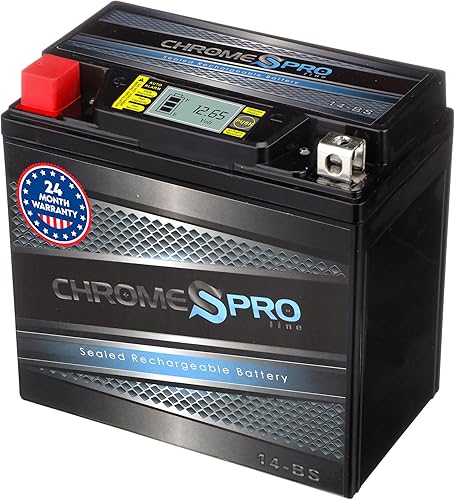
The gel picks sit at 5.91 x 3.39 inches in footprint, with the YTX14-BS at 5.71 inches tall and 10.5 pounds and the YTX9-BS at 4.21 inches tall and 6.5 pounds.
Our look at AGM vs flooded car batteries covers how sealed AGM compares to the older wet-cell design.
Which type handles vibration better?
Gel wins on vibration resistance, and that's why it suits ATVs, motorcycles and scooters. The silica gel holds the electrolyte in place so shock and jolts disturb it less.
The Chrome S Pro iGel YTX14-BS uses a gel-infused electrolyte and is rated for ATV, motorcycle, jet ski, scooter and UTV use. Its 210 cold cranking amps are enough for most powersports engines.
The same gel chemistry shows up in the compact YTX9-BS, which puts out 120 CCA for smaller bikes and ATVs.
AGM is no slouch either. The Mighty Max ML18-12 says its glass-mat construction resists shock and vibration and can mount in any position, which helps in a bouncing trailer or a scooter that rattles over rough pavement.
For a dirt bike that takes a beating on trails, gel is the safer bet. For a stationary solar bank that never moves, the vibration edge means little.
The ACDelco Gold's leak-resistant pressurized valve system does help it cope with the road vibration a car sees, even though AGM is not the top pick for the roughest terrain.
Where the vibration edge matters most
The gel advantage shows up in three places. Off-road bikes and ATVs hit washboard trails and jumps.
Scooters and mopeds buzz constantly at speed. Standby gear in a truck bed or a shed gets jostled without ever moving under its own power.
In those settings the gel electrolyte stays put and keeps the plates covered. An AGM battery handles the same vibration well, but its glass mat can loosen over years of hard jolts.
That is why the gel picks here list vibration resistance as a headline feature.
Which one starts an engine in the cold?
AGM delivers more cold cranking amps for its size, so it's the usual choice for car and truck starting. Cold cranking amps measure how much current a battery can supply at 0°F for 30 seconds.
The ACDelco Gold 94RAGM is built for exactly this job. It's a Group 94R/H7 AGM for select cars, SUVs and trucks, with a pressurized valve system and dense plate construction.
Those envelope separators and high-density plates are there to support repeated engine starts over a long service life.
Gel batteries can start engines, but they usually offer fewer cold cranking amps in the same footprint. The Chrome S Pro iGel YTX14-BS lists 210 CCA and the YTX9-BS lists 120 CCA.
That is fine for a motorcycle, ATV or small scooter engine and short of what a full-size truck needs.
The YTX14-BS compatibility list runs deep for powersports. It covers the Yamaha YZF-R6 from 1999 to 2009, the Raptor 700 line, the Grizzly 450, 550 and 700, and the Kawasaki Brute Force and Suzuki KingQuad families.
The YTX9-BS covers Honda FourTrax, Kawasaki Ninja sport bikes and Polaris Outlaw ATVs.
If you're shopping for a car, our roundup of the best AGM car batteries compares options by fit and cranking power.
How does each type handle charging?
Gel needs a gentler charge profile than AGM, so check your charger's mode before connecting either one. Gel electrolyte is sensitive to high charge voltage.
A standard AGM or flooded charger can push too much voltage into a gel battery and shorten its life. Many modern smart chargers include a gel setting for this reason.
The gel picks here ship pre-charged, so the charger question mostly comes up on the second and third charge, not the first.
AGM tolerates a wider range of charge profiles. That flexibility makes it easier to swap into vehicles and chargers that were set up for flooded batteries.
The Mighty Max ML18-12 leans on its calcium-alloy grid for float and cyclic charging, which is why it fits solar controllers set for AGM.
Neither type likes being left flat. Gel batteries hold standby charge well, but both types recover better when kept topped up on a proper maintainer.
The ACDelco Gold's 36-month warranty and the gel picks' 24-month warranty both assume normal charging, so a wrong charger profile can cost you coverage on top of battery life.
Our guide to the best car battery for the money covers value picks across battery types.
Which one lasts longer?
Gel often lasts longer on standby, while AGM recovers better from deep discharge. The difference comes from how each electrolyte handles repeated cycling.
Gel's thick electrolyte reduces the shedding that wears out plates over time. That's why gel shows up in alarm systems, solar storage and backup power.
The Chrome S Pro iGel line lists longer standby life as a direct benefit of the gel-infused electrolyte.
AGM's glass mat supports faster recharge and stronger recovery after a deep drain. For a car that sits with a dash cam or short trips, AGM is the tougher choice.
The Mighty Max ML18-12 lists deep discharge recovery as a feature, which fits solar and trolling applications.
Warranty length hints at how each maker views its own product. ACDelco backs the Gold 94RAGM for 36 months and unlimited miles on parts.
Chrome S Pro backs both iGel batteries for 24 months, with a 60-day refund window and a replacement-only policy after that.
Neither chemistry beats the other outright. How you charge, store and use the battery decides most of its service life.
The gel picks list longer standby life instead.
Is a sealed lead acid battery vs AGM battery the same question?
Not quite: sealed lead acid is the broad family, and AGM is one type inside it. Gel is another member of that family.
All three share the sealed, maintenance-free design. They differ in electrolyte and plate construction.
The Mighty Max ML18-12 even carries "SLA" in its title and "AGM" in its feature list, which shows how the labels stack.
This matters when you're reading labels. A battery marked "SLA" may be AGM or gel, so check the chemistry before you buy.
The YTX14-BS lists an OEM equivalent part number set of ES14BS, KMX14-BS, PTX14-BS and YTX14-BS, and the YTX9-BS lists a long cross-reference list including CTX9, YTR9-BS and GTX9-12B. Those numbers matter more than the chemistry name when you are matching a replacement.
Our explainer on sealed lead acid battery vs AGM battery breaks down the family tree.
For most buyers the practical question stays simple: AGM for starting, gel for vibration and standby.
Who should buy which?
Buy AGM for cars, trucks and anything that needs strong cold starts. Buy gel for powersports, standby systems and setups where vibration never stops.
For a daily driver or a stop-start vehicle, the ACDelco Gold 94RAGM is the fit. It's vehicle-specific and built around engine-starting demands.
Check the year, trim and engine before ordering, because Group 94R/H7 only covers select Audi, Buick, Cadillac, Mercedes-Benz, Chevrolet, Jeep and GMC models.
For a motorcycle, ATV or scooter, the Chrome S Pro iGel YTX14-BS is the stronger all-rounder. Its gel cells handle jolts and the LED display lets you check voltage without a tester.
The 12V 16Ah capacity gives it more reserve than the compact YTX9-BS.
For solar, tools and backup power, the Mighty Max ML18-12's deep discharge recovery suits cycling better than a starting battery. Its 12V 18Ah capacity and 6.7 pound weight make it easy to move between setups.
The budget-minded buyer
Gel batteries often cost more per amp-hour than AGM. If price drives your choice, AGM usually gives more cranking power for the money.
The Mighty Max ML18-12's 18Ah is the largest capacity in this group and it is an AGM.
The trade-off is vibration resistance. A cheap AGM may not last as long in a bouncing ATV as a gel battery would.
If your ride shakes hard, the gel premium buys real durability.
The set-and-forget buyer
If the battery sits on a maintainer in a garage or backup panel, gel's longer standby life pays off. Pair it with a charger that has a gel setting.
The YTX9-BS is a good example: small, pre-charged and easy to tuck into a compact machine.
For a vehicle that gets driven weekly, AGM's faster recharge and stronger recovery keep it healthier. The ACDelco Gold's 36-month warranty adds peace of mind for the car owner who just wants to turn the key.
The verdict: gel for most readers, AGM for the garage
The Chrome S Pro iGel YTX14-BS is the best overall pick here for most readers. Its gel electrolyte, 210 CCA and built-in LED display cover the vibration and monitoring needs that push people toward gel in the first place.
The 12V 16Ah capacity and 5.91 x 3.39 x 5.71 inch size fit a wide range of powersports machines.
The AGM battery vs gel battery choice still comes down to your use. Pick the ACDelco Gold 94RAGM for a car or truck that needs cold-start power and a vehicle-specific fit.
Pick the Mighty Max ML18-12 for solar or deep-cycle duty, where its 18Ah capacity and deep discharge recovery do the work. Pick the YTX9-BS when a compact bike or ATV needs a small gel cell with a 120 CCA rating.
If you're still weighing sealed designs, our comparison of AGM vs flooded batteries and the AGM car battery roundup help you match chemistry to your vehicle. For value picks across types, see the best car battery for the money.
Whichever you choose, match the cold cranking amps and group size to your vehicle before ordering. Chemistry sets the behavior; fit decides whether it works at all.
Frequently asked questions
Is AGM or gel better for cold weather starting?
AGM usually wins for cold starts because it delivers higher cold cranking amps for its size. Gel works fine in the cold too, but gel batteries often trade cranking power for vibration resistance and longer standby life.
Can I charge a gel battery with a regular AGM charger?
Only if the charger has a gel setting. Gel electrolyte is sensitive to high charge voltage, so a standard AGM or flooded profile can damage it.
Check the charger's mode before connecting.
Do gel batteries last longer than AGM batteries?
Gel batteries often have longer standby life when kept on a proper float charge. AGM tends to recover better from deep discharges.
How you charge and store either one matters more than the chemistry label.
Can I use a gel battery to start my car?
Gel can start an engine if the cold cranking amps match your vehicle's requirement. AGM remains the more common choice for car starting because it delivers more cranking amps in the same footprint.